Last updated 2026-08-19
TL;DR
Tent rental is the short-term hire of tents, walls, and usually the crew that stakes them. You form an entity, pull a free IRS EIN, open a state tax account if rentals are taxable, buy liability and equipment cover, and learn the local fire permit trigger (400 square feet in the model IFC). Confirm every clerk and fire board. There is no federal tent license.
What is tent rental?
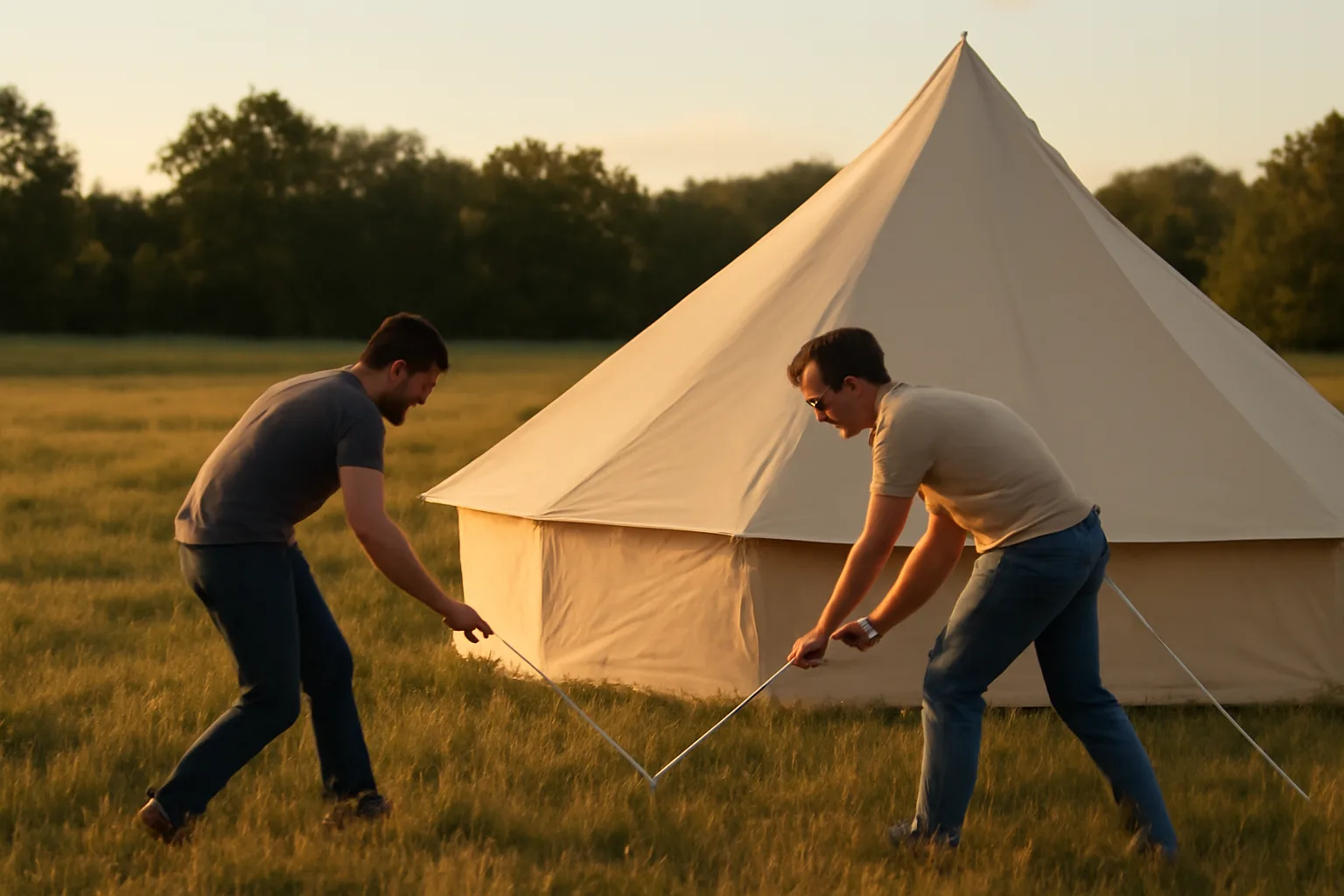
Tent rental is a short-term hire business. You own tents, sidewalls, and often floors or lights, and a customer pays for a date window plus the crew that puts the structure up and takes it down. They never buy the asset. They buy standing fabric and a strike time.
Most U.S. shops land in Census NAICS 532289, All Other Consumer Goods Rental. [14] That code is a statistical box for surveys and some bank forms. It is not a license. It does not move a fire marshal one inch.
The trade is logistics wearing canvas. Vinyl gets heavy when it rains. Stakes hit irrigation and rock. Trailers need brakes. Saturday looks like a ceremony. Sunday night is mildew control if you skip the dry.
Do not confuse this with running a venue. You put a temporary membrane on someone else's dirt, then you leave. That is why fire codes, utility locates, and landlord permission all show up in the folder. If you only drop a pop-up and walk away, you are in a thinner product line. Commercial tent rental in this country is mostly frame and pole inventory that holds dozens to a few hundred people.
Treat every paid tent as a structure, not as party decor. Decor does not catch a gust the same way. If a ridge lifts, you own that story, not the florist.
How do you start tent rental?
You start tent rental by making a legal person, pulling a free federal EIN, opening a sales tax account if your state taxes rentals, buying insurance that names the inventory, and learning the fire permit trigger in each city you serve. Then you buy tents that already carry flame certificates you can hand an inspector.
Do the paper before the purchase order. File the entity. Get the EIN the same day on IRS.gov. The IRS says, "Applying for an EIN is a free service offered by the Internal Revenue Service." [2] Then open the state tax account. Then call a broker about general liability, inland marine, and commercial auto. The 20x30 can wait a week. A tent with no named insured is just expensive fabric.
SBA's launch path is the dull one that works. Pick a structure, register the name where the state tells you to, get tax IDs, then pick up local licenses. [3][4] There is no federal tent rental license. Confirm the city clerk and the fire prevention bureau. I will not invent a fee or a processing time. Those move, and only the board in front of you can confirm them.
The national myth is a trailer plus ads. Ads with no contract, no W-9, and no flame cert is how you donate a weekend to a venue that will not let you unload. If you are still weighing this trade against a nearby job, read tent rental vs nearby career before you buy steel.
I would not open with a giant clearspan. I would open with two or three mid-size frames I can set with a small crew, dry in a barn, and replace if a storm wins.
What licenses and permits does a tent rental company need?
You need a local business license in most cities, a state seller's permit or sales tax ID where rentals are taxable, and a fire code permit for many tents over 400 square feet. You may also need a temporary use permit, a park permit, or a right-of-way permit if the tent sits on public land. Confirm each board. There is no single national form.
The 2021 International Fire Code is the model a lot of cities adopt. It states, "Tents and membrane structures having an area in excess of 400 square feet (37 m2) shall not be erected, operated or maintained for any purpose without first obtaining a permit and approval from the fire code official." [1] Local amendments exist. Some towns delete exceptions. Some write a smaller trigger. Read the adopted packet, not a forum screenshot.
Your tax person is separate from the marshal. A sole proprietor reports on IRS Schedule C. [12] An LLC is a state filing. The IRS then taxes it as a disregarded entity, a partnership, or a corporation based on elections. [13] I would form an LLC once I had employees or real inventory. Confirm that with a local attorney. This publication is not a law firm.
| Paper | Who issues it | When it shows up |
|---|---|---|
| Entity filing | Secretary of state or county | Before the first invoice |
| EIN | IRS | Before payroll or most business bank accounts |
| Sales tax account | State revenue department | Before taxable rentals |
| Fire permit | Local fire code official | Model trigger over 400 sq ft |
| Locate ticket | State one-call (811) | Before you drive stakes |
| Certificate of insurance | Your insurer | Before most venues let you unload |
Do you need a fire permit for a party tent?
Often yes if the tent is over 400 square feet, and sometimes when it is smaller because the venue or the city said so. The model IFC also has an open-sided path. Individual tents open on all sides can sit under a 700 square foot cap if they meet every listed condition, including separation. [1] Your city may have struck that exception. Ask fire prevention, not the DJ.
The 2021 International Fire Code requires a fire official permit for tents and membrane structures over 400 square feet. That is the sentence I would tape inside the trailer door, then I would still confirm the local amendment because boards rewrite numbers.
The permit is often the customer's name on the form and your problem in the field. I put in the contract who pulls it, who pays it, and who stands for inspection. Write "client handles permits," then stake a 40x60 with no paper, and you still own the failure.
Expect a floor plan, occupant load, exit widths, and a flame certificate. Cooking and portable heaters change the review. I would not run a fryer under a rental tent without the marshal in writing.
Neighboring comparison pieces such as tent rental guide 12 and tent rental guide 18 walk adjacent permit questions if you are stacking shop models.
What insurance does tent rental actually require?
Nobody publishes an honest national premium that fits your yard. What you need is commercial general liability, an inland marine or equipment floater on the tents, commercial auto, and workers' compensation once you have employees or sooner if your state says so. Venues will demand additional insured language. Confirm with a licensed agent. I will not invent a premium or a limit.
General liability answers the guest who trips a stake line. The floater answers the stolen 40x60. Auto answers the bumper in the parking lot. Skip one and you are gambling the company on a Saturday you cannot redo.
Certificate requests will eat Friday afternoon. Issue them the same day. If a hotel wants $2 million or $5 million, that is a broker conversation, not a group chat. Build a habit of asking for the venue rider before you quote, so you are not renegotiating at load-in.
I would not starve the equipment floater to save a few hundred dollars. Used clearspan is a theft magnet. Bind coverage before the first weekend, not after the first claim file sits empty.
How do you handle sales tax on tent rentals?
Many states tax the rental of tangible personal property, and a tent is usually that. You collect, you file, you keep exemption certificates when a church or a government renter is truly exempt. Some states tax labor on a different line than the tent. Confirm the Department of Revenue, not your competitor's invoice layout.
Open the tax account before the first paid job. Charging tax without authority is a mess. Skipping tax you owe is worse. The IRS EIN does not replace the state seller's permit. They solve different problems. [2][4]
Cross a state line and nexus questions show up. I will not fake a bright-line test. Call the other state's revenue department before you chase destination weekends two states over. tent rental guide 24 is a useful next read if you are comparing multi-market setups.
What flame and fabric papers do tents need?
Commercial tents need a flame story you can hand an inspector, usually NFPA 701 or the test the jurisdiction named. [9] California adds a flame-retardant registration path through the Office of the State Fire Marshal for many decorative fabrics and tent materials. [15] Buy inventory that arrives with labels and a manufacturer certificate still attached. Do not fog a no-name import and hope.
IFC Chapter 31 points flame performance at approved tests. [1] IBC Chapter 31 is the building-code cousin when a long-term membrane starts looking like a building. [10] Duration, occupancy, and whether you add walls or platforms all change the review. Confirm the building official if the tent is up past a weekend or gets used as more than a party cover.
I would walk from a cheap used tent with the label cut off. That discount is fake. Ask the seller for the cert before you send a trailer. A marshal who cannot read a tag will not accept your memory of where you bought the vinyl.
How do wind load and engineering stamps work on tents?
Big tents are structures. Wind turns them into sails. U.S. design practice runs through ASCE 7 loads as the IBC adopts them, then into manufacturer engineering or a site-specific professional stamp. [10] Fire and building officials can ask for drawings, ballast math, and a staking plan. Confirm what that official wants. I will not promise a stamp date or a quota.
Soil, buried lines, and parking-lot ballast change the numbers. Asphalt is not a cue to use more rebar and hope. A ridgeline 40x80 is not a backyard 20x20. Manufacturer charts help on a flat lawn with the listed stake pattern. They do not replace a local review when the official asks for one.
This is the one place a packaged paper set can save you from guessing. TentStakePath publishes a $179 one-time Wind-Load + Stamp Kit aimed at that packet. You can also hire a local P.E. who already walks that county. Either beats a staking video when the sky is turning green.
If you want a side-by-side of shop choices after you have the engineering question framed, tent rental guide 30 is next.
What does first-year tent rental operations look like?
Year one is a calendar, a trailer, and wet vinyl. You take a deposit, you walk the site, you get a locate ticket before steel hits dirt, you set, you walk the guy lines, you strike, you dry, you stitch. Skip drying and you grow mildew that no review will forgive.
Treat every stake as a locate job. California's one-call statute is a clear example. Government Code 4216.2 tells an excavator to delineate and notify the regional notification center before excavation. [11] Other states write their own 811 rules. Confirm the definition of excavation where you work. I still call. Hitting gas for a wedding is not a story you want attached to the shop name.
Crew size scales badly. A 20x20 is not a 40x100. I would rather decline a clearspan Saturday than show up short and leave a ridge sitting wrong. First-year operators lose more money on rushed strikes than on empty weekends.
Keep a job folder: contract, insurance cert, flame cert, site sketch, permit, 811 ticket number, punch list. Paper wins the Monday argument. tent rental guide 36 goes deeper on ops comparisons if you are stacking processes.
How should you hire and pay setup crews?
If they are employees, you withhold and you pay at least the federal floor. Federal minimum wage under the FLSA is $7.25 an hour, and many states set a higher floor you must meet. [6] Overtime rules live in the FLSA too. Call your regular setup people 1099s while you set their hours and drive them in your truck, and you are inviting a classification fight. I would put steady techs on payroll.
Heat knocks people down. OSHA's heat guidance tells employers to provide water, rest, and shade and to build acclimatization. [7] California Title 8 section 3395 goes further for outdoor places of employment, including shade when the temperature exceeds 80 degrees Fahrenheit and high-heat procedures at 95 degrees. [8] Tent work is outdoor work. Move call times earlier in July.
PPE is not optional fashion. OSHA 1910.132 says protective equipment shall be provided, used, and maintained in a sanitary and reliable condition wherever hazards of processes or environment make it necessary. [5] Gloves, eye protection around steel, and real boots are the floor I would issue. Hard hats earn their keep around frame parts on a windy site.
What contracts and site rules keep you out of trouble?
Write who owns underground risk, who pulls the fire permit, what wind speed triggers a hold or a strike, who brings ballast, and when the deposit burns. Attach a site sketch on every job bigger than a pop-up. I would not take a verbal "just show up Saturday."
Access, overhead lines, irrigation heads, and HOA rules kill more installs than missing sidewalls. Walk it. Photo it. Send the photos back with the quote so the customer cannot later claim the oak tree was a surprise.
A damage waiver is not inland marine. It helps when a guest drives a stake through a sidewall. It does not buy you a new trailer. Put both in place. Spell out ponding, sidewall snow, and who decides the tent comes down if the forecast turns.
If the site sits on a utility easement or a septic field, say so in writing and get a locate. The contract cannot fix a punctured line, but it can say who pays the locator and who stops work.
How much does it cost to start tent rental?
There is no honest single national startup price. A used 20x20 frame, a trailer, stakes, and basic cover can be a five-figure start. A clearspan fleet with trucks and a warehouse is six figures and up. I have not seen a federal series that prices tent rental startup as a line. Anyone selling a single dollar figure for "this week" is selling a course.
What I can pin: the IRS EIN is $0 on IRS.gov. [2] Entity filing fees are state-specific. Confirm the secretary of state. Insurance is quoted, not scraped from a blog. Tents vary by whether engineering rides along in the crate.
Spend first on dry storage, a legal trailer, and paper. A third pretty tent can wait. Wet vinyl in a closed trailer will cost you more than the tent you skipped. For a comparison mindset on what to buy versus what to skip, tent rental guide 42 is a straight next click.
What should you skip in year one?
Skip custom sailcloth until you can keep white vinyl clean. Skip a warehouse lease if a dry barn works. Skip "we travel anywhere" copy in month one. Skip tents with no 701 paper. Skip classifying the whole crew as contractors because a forum said so.
Do not skip the fire desk, the locate ticket, or the additional insured request. Those three keep you in business when a pretty photo will not.
The steps above work with no brand click required. If you want the wind packet path, start at /start. TentStakePath is an independent publisher, not a law firm and not a service company. Confirm every number that can move (fees, quotas, board calendars) with the board that issues the paper.
If you like reading in this series, tent rental guide 48 keeps the comparison thread going.
Frequently asked questions
What is tent rental?
Tent rental is short-term hire of tents, walls, and usually the crew that delivers and stakes them. The customer pays for a date window, not the asset. Most U.S. shops sit in Census NAICS 532289. It is a logistics trade. Fire permits, locate tickets, and insurance show up because you put a temporary structure on someone else's land.
How do you start tent rental?
Form an entity, get a free IRS EIN, open a sales tax account if your state taxes rentals, bind liability plus equipment and auto cover, then learn each city's fire trigger. Buy tents that already have flame certificates. There is no federal tent license. Confirm clerks and fire boards. Do the paper before the inventory.
Is there a federal tent rental license?
No. The federal government does not issue a tent rental license. You may need an EIN from the IRS, and you follow OSHA and FLSA if you have workers. Licensing is local and state: business license, sales tax, fire permits. Confirm the city clerk and the fire prevention bureau for the actual list on your street.
How big can a tent be without a fire permit?
In the 2021 International Fire Code model, tents and membrane structures over 400 square feet need a fire official permit. Some open-sided tents can use a 700 square foot individual cap if every listed condition is met. Your city may have changed both numbers. Confirm the adopted code, not a forum post.
What NAICS code do tent rental companies use?
Census NAICS 532289 (All Other Consumer Goods Rental) is the box most party and tent shops use. Some sit closer to general rental centers. The code is for statistics and some bank or tax forms. It does not replace a fire permit or a city business license. Confirm what your bank or state form is asking for.
Do I have to call 811 before I stake a tent?
Treat stakes as a locate job. State one-call laws differ. California Government Code 4216.2 is a hard example of notify-before-you-dig rules. Confirm how your state defines excavation. I would not drive steel on a lawn or a shoulder without a ticket number in the job folder.
Can I start tent rental as a sole proprietorship?
Yes. A sole prop reports on IRS Schedule C. An LLC is a state filing the IRS then taxes based on elections. I would use an LLC once I had employees or real inventory, and I would confirm that with a local attorney. Entity choice is not a federal tent rule and fees are state-specific.
What flame certificate do fire marshals ask for?
Most ask for NFPA 701 (or the test named in the adopted fire code) plus a manufacturer certificate and sewn-in labels. California adds Office of the State Fire Marshal flame-retardant rules for many fabrics. Do not buy used tents with the labels cut off. Ask for the cert before you send money.
Are tent rentals subject to sales tax?
Often yes, because many states tax rentals of tangible personal property. Labor may be taxed on a different line. Exempt customers need valid exemption certificates in your file. Confirm the Department of Revenue before the first invoice. Crossing a state line adds nexus questions you should ask that other state.
Do pop-up canopies need the same paper as frame tents?
Small pop-ups can fall under fire-code size exceptions, and some cities still want to know if you stack several of them. Commercial frame and pole tents over the local square-foot trigger get the full permit path. Confirm the fire desk. Do not assume pop-up means no paper, especially on public property.
What insurance certificates do venues ask for?
Venues usually want a certificate of insurance with general liability, additional insured language, and sometimes a waiver of subrogation. They may also want auto and higher limits. Your own shop still needs an equipment floater. Confirm wording with a licensed agent. I will not invent a premium or a required limit.
Should I buy used tents in year one?
Used mid-size frames are a reasonable year-one buy if the flame labels and manufacturer certs are intact and the vinyl is dry. Skip unlabeled imports and any tent with mystery repairs on structural parts. I would spend first on dry storage and a legal trailer, not on a third pretty unused sailcloth tent.
Sources
- ICC International Fire Code 2021 Chapter 31: Model IFC requires a fire official permit for tents and membrane structures over 400 square feet, with an open-sided individual tent exception capped at 700 square feet when listed conditions are met.
- IRS Apply for an Employer Identification Number (EIN) Online: Applying for an EIN is a free service offered by the Internal Revenue Service.
- U.S. Small Business Administration Register your business: SBA launch guidance is to pick a structure and register the business name with the governments that require it.
- U.S. Small Business Administration Get federal and state tax ID numbers: New businesses need federal and, where required, state tax identification numbers after choosing a structure.
- OSHA 29 CFR 1910.132 Personal Protective Equipment: Employers must provide, use, and maintain PPE wherever process or environmental hazards make it necessary.
- U.S. Department of Labor Minimum Wage: Federal minimum wage under the FLSA is $7.25 per hour.
- OSHA Heat Exposure: OSHA heat guidance tells employers to provide water, rest, and shade and to use acclimatization for outdoor heat risk.
- California Code of Regulations Title 8 section 3395: California outdoor heat-illness rule requires shade above 80°F and high-heat procedures at 95°F for covered outdoor places of employment.
- NFPA 701 standard detail page: NFPA 701 is the standard method of fire tests for flame propagation of textiles and films used for tent fabrics.
- ICC International Building Code 2021 Chapter 31 Special Construction: IBC Chapter 31 covers membrane structures and special construction that can apply when a tent is reviewed as more than a short party cover.
- California Government Code section 4216.2: California requires an excavator to delineate the area and notify the regional notification center before excavation.
- IRS About Schedule C (Form 1040): Sole proprietors report business profit or loss on IRS Schedule C.
- IRS Limited Liability Company (LLC): An LLC is created under state law and the IRS taxes it as a disregarded entity, partnership, or corporation depending on elections and owners.
- U.S. Census Bureau NAICS 2022 detail 532289: NAICS 532289 is All Other Consumer Goods Rental, the statistical box commonly used for party and tent rental shops.
- CAL FIRE Office of the State Fire Marshal Flame Retardant Chemicals and Fabrics: California OSFM runs the state flame-retardant chemicals and fabrics program that applies to many tent and decorative fabrics.