Last updated 2026-08-19
TL;DR
Tent rental is the short-term hire of membrane structures and event gear. You start by forming an entity, getting a free EIN, buying insurance venues will accept, and treating every job as a local fire and zoning file. Tents over 400 square feet usually need a permit under the International Fire Code. Confirm every fee and form with your city or county board.
What is tent rental?
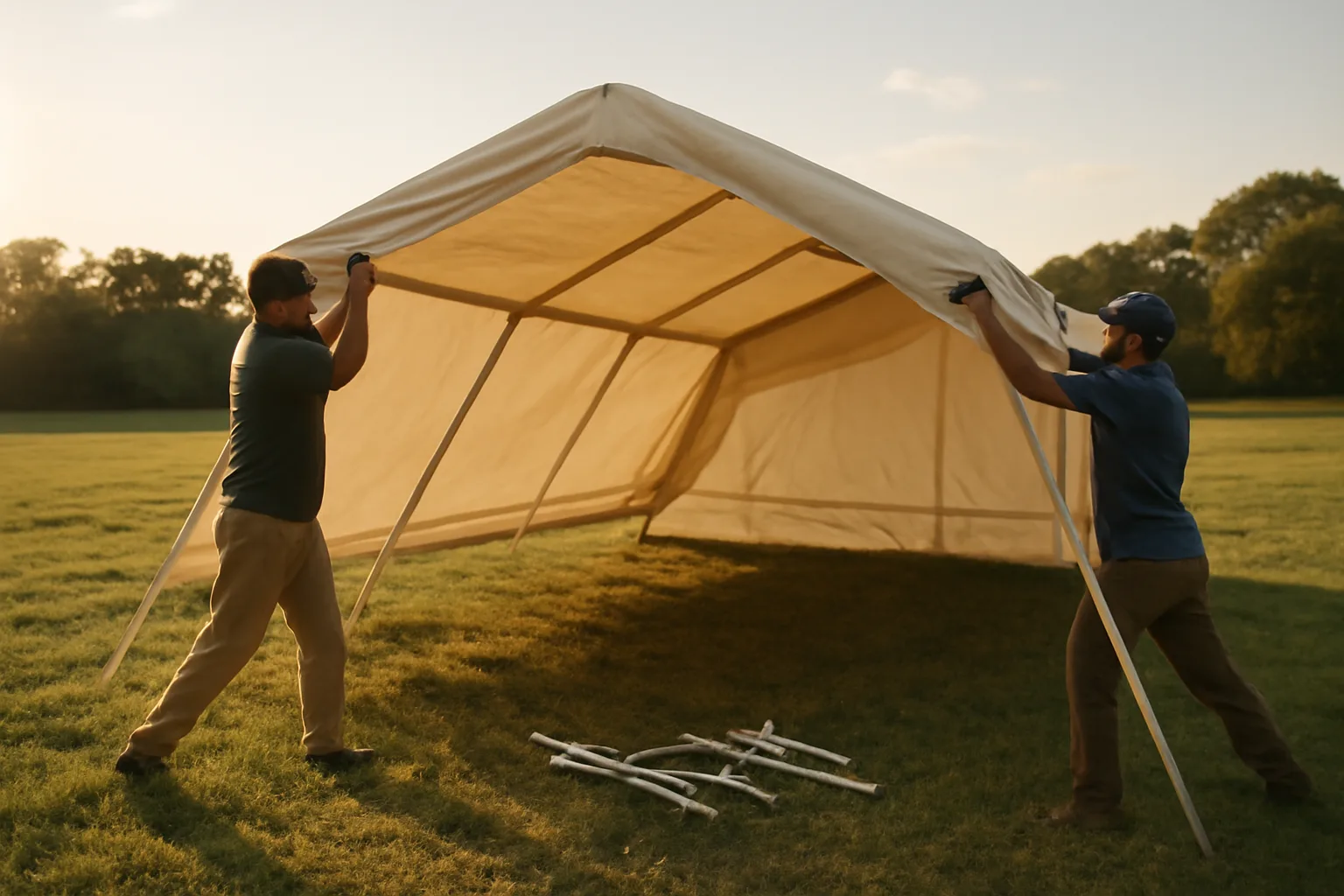
Tent rental is the short-term hire of temporary membrane structures (frame tents, pole tents, and tension or clearspan units) plus the labor to deliver, install, and strike them. You bill by the day or the event. You are selling installed shelter, not fabric on a hanger.
Most books mix the tent with sidewalls, lighting, floors, HVAC, and tables. The U.S. Census Bureau parks a lot of this work in NAICS 532289, All Other Consumer Goods Rental, a code that includes party supply rental stores [6]. That code is a statistical bucket. It is not a license and it will not get you onto a park lawn.
The job is physical and local. You drive. You stake or you ballast. You watch weather cells on your phone. You stand next to a fire inspector who has never met you. Wind and rain cancel more revenue than any rival shop. If you hate late calls, pick another trade.
People mix tent rental with camping retail. Different product. Different paper. Event tents are temporary structures under the fire code. Camping tents are consumer goods. Show up to a city festival with the wrong flame file and you fold the job in the parking lot.
Here is the clean line. Tent rental is a field-installed rental service. It lives on permits, weather, and crew. It does not live on a pretty showroom.
How do you start tent rental?
You start tent rental by picking a legal structure, getting a free EIN from the IRS, opening a bank account that is not your personal checking, buying insurance a venue will accept, and reading your fire official's tent packet before you buy a pole. Inventory is second. Paper is first.
I would form an LLC in most states if I had a house or savings I wanted to keep off the table. The SBA is blunt that structure changes taxes and how much of your personal assets sit in the blast radius [5]. Sole prop is faster. It also puts your name on the lawsuit. Confirm the filing fee and the exact form with your secretary of state. Do not trust a blog's fee chart. Those rot.
Get the EIN yourself on IRS.gov. The Service says, "Applying for an EIN is a free service offered by the Internal Revenue Service" [4]. Never pay a reseller. I will not promise you a same-day number. Confirm the current online steps on that page.
Then call the fire prevention desk that covers your first likely venues. Ask what they want for a 20x20, a 40x60, and a tent with sidewalls. Write it down. That one call saves more money than any Facebook group.
Buy inventory last. A used frame tent, enough ballast or stakes, a truck that stays under the CDL line if I can help it, and a storage corner I can lock. That is the whole starter list. If you want a side-by-side with other first jobs, read tent rental vs nearby career. For a narrower starter map, tent rental guide 12 is the next click.
Do you need a license to rent tents?
There is no federal tent rental license. You need a local business tax certificate in most cities, a sales tax permit if your state taxes rentals, and a fire permit for many tent sizes. Some counties also want a general business registration. Confirm each item with the clerk and the fire marshal. Nobody mails you a national "tent guy" card.
The SBA walk-through on registering a business is the right federal starting map, then you drop to state and city desks [15]. Sales and use tax on rented tangible property is a state department of revenue question. I have seen states tax the tent and skip the labor, and the reverse. Do not copy a neighboring state's rule.
Hire anyone and federal wage and hour rules apply. The federal minimum wage for covered nonexempt employees is $7.25 an hour [11]. Your state may be higher. Confirm with your state labor department before you write the first offer.
A park, hotel, or school will still treat you as unlicensed if you cannot hand them a certificate of insurance. That certificate is not a license. It is the document that opens the gate.
What size tent needs a fire permit?
Under the 2021 International Fire Code, tents and membrane structures over 400 square feet need a permit and fire official approval, with written exceptions [1]. Your city may have adopted that edition, an older one, or a state fire code with another cutoff. Read the adopted text. Do not guess from a group chat.
The code text is not vague. It says, "Tents and membrane structures having an area in excess of 400 square feet shall not be erected, operated or maintained for any purpose without first obtaining a permit and approval from the fire code official" [1]. There is a camping-tent exception. There is also an open-on-all-sides path that can reach 700 square feet if you keep a 12 foot break to other tents and buildings [1]. A grid of 10x10 pop ups pushed together can blow that aggregate. Measure the field, not one canopy.
Temporary tents under that code may not sit on a single premises more than 180 days in a 12 month span [2]. Open flame, cooking gear, and similar devices stay 20 feet off the tent unless the fire official says otherwise [3]. Those three numbers (400, 180, 20) are the ones I would paint on the shop wall.
Confirm the edition your board actually adopted. A 2018 town is not a 2021 town. If you want more code-path walkthroughs in this series, tent rental guide 18 and tent rental guide 24 keep the same paper tone.
What paper do you file in the first year?
Year one paper is a short stack you can name, not a mystery binder. You file entity papers with the state, an EIN with the IRS, a sales tax permit if your state taxes rentals, a local business certificate, and then a fire or special-event permit on each job that crosses the local size trigger. Insurance certificates ride with the quote.
IRS Publication 583 is the federal records primer for a new shop [10]. Keep mileage, crew hours, permit receipts, and repair bills in one place from week one. Sloppy books cost more than software.
Employees add one line. Complete Form I-9 and keep it for the retention period in the USCIS Handbook for Employers (M-274) [12]. Confirm the current keep-until date on that handbook. I will not invent a processing time for any of this.
| Filing | Who issues it | When it shows up |
|---|---|---|
| Entity (LLC or corp) | State secretary of state | Before you sign venue contracts |
| EIN | IRS | Banking, 1099s, payroll |
| Sales or use tax permit | State revenue department | If your state taxes tent rentals |
| Local business certificate | City or county clerk | Before you advertise in that city |
| Fire or special event permit | Fire official or parks desk | Per job, by their size rules |
| Form I-9 | You keep it, USCIS writes the rules | First employee |
Hand a W-9 to every venue that asks. Ask them for the additional-insured wording before Saturday. That is the whole dance.
How much cash does a tent rental start actually take?
Nobody publishes a clean national starter number for tent rental. Census revenue for NAICS 532289 mixes you with other consumer goods rental, so it will not tell you what a used 20x20 and a 16 foot box truck cost on Tuesday [6]. The honest range is wide because used frame inventory, a truck, and a storage bay dominate cash. The paper itself is cheap next to aluminum.
I would spend first on a road-legal truck, a 20x20 or 20x30 frame I can lift with two people, stakes and water barrels, a flame certificate that matches the fabric, and insurance. A new clearspan in month one is a waste of money for most books. So is a wrap on the truck.
State entity fees vary. Confirm them on the secretary of state's fee page. Federal EIN is free [4]. Local business certificates and fire permits are board-set. I will not invent those fees here. Call the board that will stamp your first job.
Hold a cash buffer for a rain-out. One wet June can erase a month of Saturday deposits. If you want another cut of first-year choices, tent rental guide 30 is built for that.
What insurance do tent rental operators carry?
You carry general liability, inland marine (the tents and gear in transit and on site), commercial auto, and workers compensation once you have employees. Venues add a request for additional insured status and sometimes a waiver of subrogation. Umbrella shows up when a hotel or city writes a high limit into the contract.
I will not invent a premium or a "standard" limit. The venue writes the number. Read the contract. If you cannot buy that limit, walk away from that lawn. A cheap policy that a park rejects is not cheap.
Inland marine is the line people skip and then cry about. Wind does not care that your GL is paid up. Fabric, plate, and lighting leave the building. Insure them as scheduled gear.
Ask the agent for a sample certificate with your entity name spelled the same way as your state filing. Mismatched names stall more Saturday installs than missing stakes.
Do you need a CDL to haul tents?
You need a CDL when the truck or combination meets the federal commercial motor vehicle definition, which includes a gross vehicle weight rating of 26,001 pounds or more under 49 CFR 383.5 [8]. Many first-year operators stay under that line on purpose.
Read the door sticker, not the salesman's story. GVWR is the rating. It is not what the scale said last Thursday. A trailer can push a light truck over the line. Add the ratings before you buy.
Passenger and hazmat triggers also live in that same definition [8]. You are not running a bus. You still should read the text once.
I would rather own two mid-size trucks than one heavy truck I cannot legally drive on Monday. Training time and medical cards are real costs. Confirm current state CDL steps with your motor vehicle agency. No timing promises.
What wind, stamp, and safety rules hit the site?
Wind is the design load. Many fire officials want the manufacturer's install instructions on site. Larger or unusual layouts, public assembly, and high-wind counties often want a professional engineer stamp against the adopted load standard. Confirm that with the official who will walk the lawn. I will not tell you a stamp is "always" or "never."
If you want a packet that walks through wind-load language and stamp request steps, TentStakePath sells a $179 one-time Wind-Load + Stamp Kit. It does not replace your engineer or your fire official, and it does not approve a job.
On the crew side, general industry fall rules kick in at 4 feet on unprotected edges [7]. Treat the install as construction and the trigger drops to 6 feet [7]. Either way, climbing a wet frame without a plan is how people get hurt. Pick ballast or stakes from the site, not from habit. Call 811 before you drive steel. The FCC's 811 guide is the federal reminder to call before you dig [13].
Public events also trip accessibility rules. The 2010 ADA Standards are the federal design text if the public is invited onto that route [9]. A 6 inch lip at the entrance is a real complaint waiting to happen.
How should you price a first year tent job?
Price from hours, miles, wear, permits, and rain risk. Do not copy a national rate card you found on a forum. Those cards ignore your fire fee, your two-person crew, and your 90 minute drive.
Build a floor. Truck plus two techs for install and strike. Add stake or barrel time. Add a wear slice on fabric and plate. Add the actual permit fee after you confirm it with the board. Then add a weather hold or a written rain clause. If the number scares the client, let it. Cheap jobs wreck first years.
I would not discount a 40x60 because a hotel "might send more work." They will send more work at the same discount.
Keep every quote tied to a site sketch and a wind plan. If you cannot name the soil and the nearest hydrant, you are not ready to send a number. For more comparison reading, tent rental guide 36 sits next to this one.
What tent rental gear should you buy first?
Buy a used frame tent you can raise with two people, matching sidewalls, a stake kit, water barrels or blocks, rated tie-downs, and a flame certificate that stays with that tent. Add lights only after you have a GFCI plan and a generator or shore-power rule you can explain to an inspector.
Skip the giant clearspan. Skip custom prints. Skip a showroom. Those are ego buys. A second 20x30 will book more Saturdays than one 40x100 you cannot staff.
Pole tents are cheaper on fabric and meaner on stakes and lawns. Frame tents cost more and play nicer on patios and pavers. I would start frame if my first calls are hotels and backyards. I would start pole if my first calls are open fields and I have permission to drive steel.
Label every bag. Lost pins eat margins. So do unlabeled sidewalls that do not match the next job's color story. Boring inventory wins year one.
How do fire inspections of rental tents work?
The inspector wants a permit (if your size triggers one), flame documentation, exits, extinguishers, clear edges, and a layout that matches what you filed. IFC Chapter 31 is the model text a lot of towns point at [1]. Your adopted code is the one that counts.
Flame work traces to NFPA 701 test methods for textiles and films [14]. Keep the certificate with the tent, not in a drawer at the shop. If the label and the paper disagree, the inspector will believe neither.
They will walk stakes, ballast, guy lines, and cooking gear. Open flame stays 20 feet off unless they approve a closer setup [3]. Generators and propane get their own questions. Answer with distances, not vibes.
Fail an item and you take notes and fix it. Arguing code from memory on a lawn is a bad look. Bring the adopted section printed. Bring the site plan. Bring the COI. That is the inspection.
Is tent rental a better start than nearby work?
It can be, if you like field work and you can stand weather risk. It is a poor start if you wanted indoor hours and a fixed paycheck. Nearby trades with a W-2 will beat you in a wet May. You may beat them in a dense wedding fall. Nobody has a clean public study that isolates first-year tent rental profit. The closest official bucket, NAICS 532289, mixes you with other rental shops [6].
I would run tent rental as a Saturday business beside other income until three months of deposits cover the truck note, insurance, and a rain-out. Then I would quit the other job. Not before.
Want the kit after you have read the code yourself? The path is /start. TentStakePath is an independent publisher, not a law firm and not a service company. Confirm every fee, form, and stamp with the board that will stand on your grass.
For more side-by-side reading, use tent rental vs nearby career and tent rental guide 42.
Frequently asked questions
What is tent rental?
Tent rental is short-term hire of frame, pole, or tension tents plus the crew to install and strike them for events or sites. You rent installed shelter, often with sidewalls, floors, and lights. It sits in the consumer goods rental statistical bucket (NAICS 532289), not under a national license. Local fire and business paper still apply.
How do you start tent rental?
Start with an entity filing, a free IRS EIN, a dedicated bank account, insurance a venue will accept, and a call to the fire official who covers your first lawns. Buy a small used frame tent and a truck after that paper exists. Confirm every local fee with the clerk and the fire desk. Do not pay a website for an EIN.
Is there a national license for tent rental?
No. The United States does not issue a national tent rental license. You stack a state entity, tax permits if your state taxes rentals, a local business certificate, and per-job fire or park permits. Insurance certificates are what venues ask for at the gate. Confirm the stack with your city clerk and fire marshal.
How big can a tent be without a fire permit?
The 2021 International Fire Code uses 400 square feet as the main permit trigger, with an open-on-all-sides path that can reach 700 square feet if spacing rules are met. Your town may have adopted a different edition or a state fire code. Recreational camping tents are treated differently. Read the adopted text for that address.
Do 10x10 pop up canopies need a tent permit?
A single small pop up is usually under the 400 square foot IFC trigger. Line a dozen of them up without a 12 foot break and the aggregate can cross the open-sided exception. Fire officials look at the field, not one canopy. Ask the official who owns that lawn before you advertise a "permit free" village of pop ups.
Do I need a PE stamp for every wedding tent?
No. Many backyard 20x20 frame jobs run on manufacturer instructions and a local permit, if a permit is even required. Larger clearspans, public assembly, unusual ballast plans, and high-wind sites are where officials ask for an engineer. Confirm with the authority having jurisdiction. I will not promise a stamp gets you approved.
Can I run tent rental as a sole proprietor?
Yes. The SBA notes that structure changes taxes and how much of your personal assets are at risk. Sole prop is simple and puts claims next to your house. An LLC costs a state filing fee you must confirm with the secretary of state. Get a free EIN either way if you want a bank account that is not your personal name.
What insurance do venues want from tent rental shops?
They want a certificate that names your legal entity, lists general liability, and adds them as additional insured for the event date. Many also ask about auto and, if you have staff, workers compensation. Limits are written in their contract, not in a national rule. If you cannot buy the limit, decline the job.
Do I charge sales tax on tent rental?
It depends on your state. Many states tax rentals of tangible personal property. Some tax the tent and treat labor apart. Some exempt certain nonprofits. Confirm with your state department of revenue and keep that written answer in the job folder. Do not copy a rate from a neighboring state.
Do I have to call 811 before staking a tent?
Yes, treat driven steel like any other dig. The FCC's 811 consumer guide tells people to call before digging so buried lines get marked. Water barrels on a hard patio are a different site. Stakes in a lawn are not. Build the 811 ticket into your lead time and keep the ticket number with the job packet.
How long can a rental tent stay up?
The 2021 International Fire Code limits temporary tents on a single premises to 180 days inside a 12 month period. Your adopted code may differ. Zoning and park rules can be shorter than the fire code. If a client wants a winter-long structure, you are in a different permit world. Confirm with the fire official and the zoning desk.
Should a first-year shop buy a frame tent or a pole tent?
Buy a used frame tent if your first calls are hotels, patios, and backyards that hate stake damage. Buy pole if your first calls are open fields and you can get written leave to drive steel. I would not buy a new clearspan in year one. Crew and ballast matter more than span width on Saturday morning.
What should I do before I buy inventory?
File the entity, get the free EIN, talk to an insurance agent who already writes rental shops, and call the fire prevention desk for two real venue addresses. Ask them what they want for a 20x20 and a 40x60 with sidewalls. Then buy the smallest frame you can book. Paper first. Poles second.
Sources
- ICC, 2021 International Fire Code Chapter 31 (Section 3103.2): Tents and membrane structures over 400 square feet require a fire permit and approval, with listed exceptions including certain open-sided tents up to 700 square feet.
- ICC, 2021 International Fire Code Section 3103.5: Temporary tents and specified membrane structures shall not be erected for more than 180 days within a 12-month period on a single premises.
- ICC, 2021 International Fire Code Section 3107.4: Open flame and similar devices are not permitted inside or within 20 feet of the tent while open to the public unless approved by the fire code official.
- IRS, Apply for an Employer Identification Number (EIN) Online: Applying for an EIN is a free service offered by the Internal Revenue Service.
- U.S. Small Business Administration, Choose a business structure: The business structure you choose influences operations, taxes, and how much of your personal assets are at risk.
- U.S. Census Bureau, 2022 NAICS definition 532289: NAICS 532289 (All Other Consumer Goods Rental) includes establishments such as party supply rental stores.
- OSHA, 29 CFR 1910.28 Duty to have fall protection: In general industry, employees on unprotected edges 4 feet or more above a lower level must be protected from falling.
- eCFR, 49 CFR 383.5 Commercial motor vehicle definition: A commercial motor vehicle includes a vehicle with a GVWR or GCWR of 26,001 pounds or more used in commerce to transport passengers or property.
- U.S. Department of Justice, 2010 ADA Standards for Accessible Design: The 2010 ADA Standards are the federal accessibility design standards that apply when the public is invited onto routes and spaces.
- IRS, Publication 583 Starting a Business and Keeping Records: Publication 583 is the IRS primer on records a new business should keep.
- U.S. Department of Labor, Federal minimum wage: The federal minimum wage for covered nonexempt employees is $7.25 per hour.
- USCIS, Handbook for Employers M-274: The USCIS M-274 handbook states the Form I-9 retention rules employers must follow.
- FCC, Call 811 Before You Dig consumer guide: The FCC reminds the public to call 811 before starting a digging project so buried utilities can be marked.
- NFPA 701 Standard Methods of Fire Tests for Flame Propagation of Textiles and Films: NFPA 701 sets the fire test methods for flame propagation of textiles and films used in tents.
- U.S. Small Business Administration, Register your business: SBA maps federal, state, and local registration steps for a new business, which then drop to city and county desks.