Last updated 2026-08-19
TL;DR
Tent rental is short-term hire of event tents plus the labor to install and strike them. You start with a real entity, an EIN, local tax accounts, insurance, and inventory the fire code will accept. Most tents over 400 square feet need a local fire permit and a flame certificate. No national tent rental license exists. Confirm every fee and form with the fire marshal, the city, and the state board that actually signs the page.
What is tent rental?
Tent rental is the short-term hire of temporary event tents and the crew that delivers, stands, and later removes them. You own or lease the inventory. You charge for size, days out, labor, mileage, and extras such as walls, liners, and lighting. Every install is still a temporary structure under the fire code.
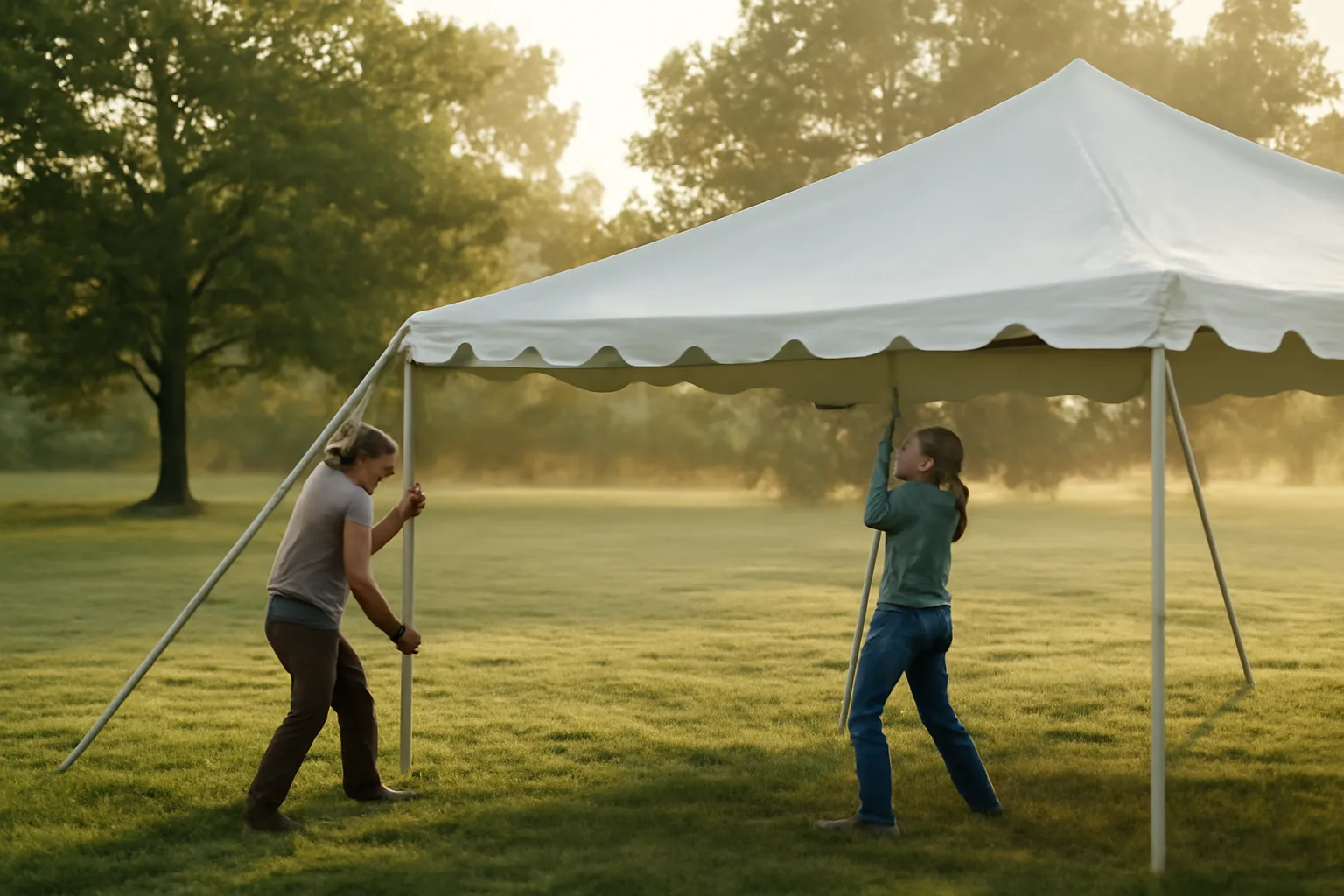
That is the whole trade. A date gets held. Stakes or ballast go in. A frame, pole, or clearspan tent goes up. Sides and lights go on if the order says so. You come back when the event ends and the grass is a mess.
The U.S. Census Bureau files most party and event rental under NAICS 532289, All Other Consumer Goods Rental, which includes establishments that rent party supplies [11]. You are not a campground shop. You are not a general contractor by default. You are a rental house whose product happens to occupy air and block exits.
The International Fire Code puts that product in Chapter 31, tents, temporary special event structures, and other membrane structures [1]. Inspectors care about area, exits, flame spread, and whether the thing stays put in wind. Customers care about shade and photos. You satisfy both or you do not get paid.
I would not brand yourself as a venue in year one. Venue language pulls liquor, occupancy, and assembly rules you may not want yet. Stay a rental house until the basic paper is boring.
Cash arrives in weekend lumps. Weather deletes jobs. Crew no-shows happen on 95 degree Saturdays. If that mix sounds fine, keep reading.
How do you start tent rental?
You start tent rental by forming a real business, getting tax IDs, opening the local license and sales tax accounts your city and state actually use, buying or leasing code-ready inventory, and treating every install as a permitted temporary structure. There is no federal tent rental card. The SBA says the licenses and permits you need depend on your business activities and location [3].
Do the entity first. A sole proprietorship is fast if you are testing one used tent and have no partners. An LLC is what I would file the day a truck, a second person, or a warehouse lease is in the picture. The SBA notes that the structure you choose affects day-to-day operations, taxes, and how much of your personal assets are at risk [4]. Confirm formation forms with your secretary of state. A blog checklist is not the filing.
Get an EIN on IRS.gov. The IRS charges nothing for that filing [2]. Then open whatever seller's permit or sales tax account your state revenue department uses. Event tents are usually tangible personal property when you rent them. Some states tax the labor line too. Ask the state, in writing.
Insurance binds before the first stake. A truck that can legally carry the load comes next. Storage that is dry and not a zoning fight comes after that. Inventory lands last among those, which feels backward until you watch someone buy $80,000 of sailcloth and then learn their alley will not take a 24 foot trailer.
Build a one-page install packet before you take deposits: flame certificate, manufacturer wind guidance, a blank site sketch, and a certificate of insurance template. Year-two paper is a different pile. If you later work tent rental renewal in california or tent rental renewal in florida, those packets will not match each other. Confirm every current fee with the board that cashes the check. Nobody honest will promise you an approval date.
Do you need a special license for tent rental?
No national tent rental license exists. You need the ordinary small-business stack plus, on most paying jobs, a local fire or building permit for the tent itself. The SBA states that required licenses depend on your business activities and location [3].
The ordinary stack is an entity filing, an EIN, a city or county business tax certificate if your city uses one, and a state sales tax account. Hire anyone and you add state withholding and unemployment accounts, plus the federal wage rules you should read before the first Saturday [10]. If walk-in customers come to a showroom, ADA Title III rules for public accommodations can reach that space [13].
A contractor license is a separate question. Many states treat tent install as rental labor, not building contracting. Some local building departments disagree the moment you add flooring, power distribution, or a stage. I would call the contractor board and the fire marshal before I printed invoices that say "structure package." Get the answer in an email.
Special event promoter licenses, park use permits, and right-of-way permits sit on the customer side more often than yours. Still, take a job in a city park and the park's vendor rules can land on your truck. Confirm that packet for that site.
Skip anyone selling a "national tent license kit." That product is a folder. After the first season, state renewal chores split hard. Tent rental renewal in georgia is not the same errand as tent rental renewal in arizona.
How big can a tent be without a fire permit?
Under the International Fire Code, tents and membrane structures over 400 square feet need a permit and fire official approval before you erect them, with listed exceptions [1]. IFC 3103.2 states: "Tents and membrane structures having an area in excess of 400 square feet shall not be erected, operated or maintained for any purpose without first obtaining a permit and approval from the fire code official."
Read the exceptions on the same page. Recreational camping tents are carved out. Tents open on all sides can also be excepted if they stay at or under 700 square feet and meet the spacing and aggregate-area rules in the code [1]. Those exceptions are not a handshake. They are text the official can still read against your lot lines and your cluster of three 20x20s.
Your city may have adopted IFC, a state fire prevention code, or a local rewrite. The 400 square foot trigger is the number I plan around unless the authority having jurisdiction hands me a written local rule that is tighter. Some downtown historic districts run tighter. Some fairgrounds run their own event office.
I pull a permit whenever the footprint is close. Fighting a stop-work order on a wedding day costs more than the permit ever will. Pass the fee through as a line item. Do not hide it.
| Trigger | What you file | Who says yes |
|---|---|---|
| Tent or membrane structure over 400 sq ft | Fire permit, layout, flame cert | Local fire code official [1] |
| Open on all sides, 700 sq ft or less | Possible IFC exception, still ask | Same official, in writing [1] |
| Cluster of small tents | Aggregate area and separation check | Same official [1] |
| City park or street | Site use or right-of-way permit | Parks or public works, plus fire |
Confirm the adopted code edition. IFC 2021 is the text cited here. Your town may still run an older book.
What flame certificate does a rental tent need?
Most permitted event tents need a certificate showing the fabric meets flame propagation tests, usually NFPA 701 as referenced by the fire code, before the official grants the permit [1]. IFC 3104.2 tells the owner or agent to file a certificate from an approved testing laboratory for the tent and its appurtenances [1].
Keep the cert with the tent, not in a junk drawer at the shop. Inspectors ask on the grass. A photo of a 2014 PDF on your phone is a weak move. A labeled packet in the cab is the strong one.
California writes an extra statute on top of model code. Health and Safety Code section 13115 makes it unlawful to operate certain fabric enclosures for assemblages unless the fabric is nonflammable or treated and maintained in a flame-retardant condition [9]. Send inventory to California jobs and you treat that statute as live paper, not trivia.
Sidewalls, liners, and decorative drapes get people in trouble. The top can be clean and the ceiling liner can be a clearance-rack polyester. If you did not buy it as a rated accessory, do not hang it on a permitted tent.
I would not spray a mystery bottle on used vinyl and call it treated. Either the mill cert is current or you retire that roof. Re-treatment, where a lab or the State Fire Marshal process allows it, is a documented process. Confirm the current method with the official who will stand under the tent.
How much money do you need to start tent rental?
There is no honest national startup total for tent rental. Inventory quotes swing with used versus new, frame versus clearspan, and whether a forklift is already in the family. Anyone handing you a single "start for $X" figure is selling a course.
The IRS treats this as a trade or business once you are in it for money, with ordinary and necessary expenses going on the business return, often Schedule C for a sole proprietor [8]. That tells you how the year gets reported. It does not tell you what a 40x60 costs this month.
Build your own sheet. Lines I would include: two installable tents you can stand with the crew you actually have, stakes and ballast, a trailer or truck that is legal for the weight, storage, insurance binders, permit deposits, a reserve for one rain-out month, and wages if you will not work alone. Pub 334 is the IRS overview of how self-employed federal tax rules work, not a budget template [8].
Waste of money in month one: a custom sailcloth catalog, a monogrammed dance floor, and a wrap on the truck. Buy used commercial frame inventory from a rental house that is exiting, then spend on stakes, bases, and a torque-rated driver. Pretty fabric does not pull a permit.
Hold a cash reserve. A single popped vinyl roof in May can eat a month of deposits. I would not open the books until I could lose one mid-size job and still make payroll and the lot rent.
What insurance does a tent rental company need?
You need the coverages your venues, landlords, and state employment rules demand in writing, usually general liability, hired and non-owned or commercial auto, inland marine on the gear, and workers compensation once you have employees. No single federal "tent insurance" statute sets your dollar limit.
The number on the certificate of insurance is a contract number. Parks, hotels, and private estates pick it. I would not invent a legal minimum here. Ask the venue for the required form and limits, then have a licensed broker match that form. If they want additional insured language, get the endorsement, not a polite email.
Auto is where people get surprised. A 1-ton that was personal last year is commercial the day it hauls inventory to a paying job. State DMV and your auto carrier both need the true use.
Workers compensation is state law once you have employees. If you are truly alone, some states still offer or require an option. Confirm with the state workers compensation agency. Do not take a forum post over the board.
Inland marine, the floater on tents sitting at a venue overnight, matters more than a shiny umbrella in year one. Gear spends the night on other people's lawns. Uninsured theft at a farm is a bad business model.
Do tent rental trucks need a USDOT number?
Many tent trucks need a USDOT number when they carry property in interstate commerce and the vehicle's gross vehicle weight or weight rating is at least 10,001 pounds [6]. FMCSA's own registration page is the checkpoint, not a Facebook group.
Intrastate-only hauls follow your state patrol or DMV rules, which may copy the federal weight or use another threshold. Confirm with that state office before you cross a county line with a loaded trailer every weekend and call it local.
A CDL is a different card. Federal CDL rules reach combination or single vehicles at 26,001 pounds GVWR, plus passenger and hazmat cases you probably do not want [7]. Plenty of first-year operators stay under that number on purpose. I would too, until the clearspan work forces a heavier truck and a licensed driver.
Weigh the loaded rig. Stenciled GVWR on the door jamb plus a loaded scale ticket beats a guess. If you are over, file. If you are under, keep the ticket in the glove box for the day someone argues.
Medical cards, hours rules, and inspections stack on after USDOT, not before. Do not collect decals you do not need. Do not skip the ones you do.
How should you price tent rental in year one?
Price tent rental as days-out plus labor hours plus mileage plus permit pass-through, then add a weather and damage rule you will actually enforce. Copying a national rate sheet is how you go broke in a cheap county or get laughed out of a coastal one.
Start from your real hourly crew cost under federal wage rules if you have employees, including overtime after 40 hours in the workweek unless an exemption really applies [10]. Saturday install plus Sunday strike blows a 40 hour week by noon Monday. If you cannot say the overtime number out loud, you cannot price the weekend.
Charge for the days the tent occupies your fleet, not only the event date. A Friday drop for a Sunday wedding is three days out. People who price one calendar day train customers to trap their inventory.
Permits, extra stakes for bad soil, and generator fuel are pass-throughs or pre-priced adders. I would print them. Surprise invoices after the vows create chargebacks.
Do not discount the first three jobs to "get photos." Discounting trains the only customers who call back. If you want photos, shoot your own install at cost and keep the rate card intact.
What tent rental equipment should you buy first?
Buy two commercial frame tents you can stand with your actual crew in one morning, plus enough stakes, bases, and sidewall to finish a real order. That is the starter set. Everything else waits.
A used 20x20 and a used 20x40 (or 20x60 if you already have the hands) will teach you soil, wind calls, and crease repair. Clearspan and sailcloth wait until you have a forklift, a taller shop door, and a customer who already pays you on time.
Waste of money: cheap big-box party canopies with no mill cert, no replacement parts, and legs that walk in a breeze. You cannot permit that junk. You also cannot repair it on a lawn at 4 p.m.
Match the trailer to the longest tube you will haul. Overhang laws are state-specific. Lights and dance floor come after you have turned away two jobs because the tents were already out. Furniture is a different business with a different damage rate.
PPE is equipment. OSHA's general PPE rule requires that needed protective equipment be provided, used, and maintained in a sanitary and reliable condition [5]. Gloves, hard hats when you are under steel, and eye protection around drivers are not optional theater. Heat on a July install is an OSHA heat-exposure problem, not a toughness contest [12].
What wind load paper do inspectors actually ask for?
Inspectors ask for the manufacturer's install manual, a layout that shows stakes or ballast, and, on larger or sensitive sites, an engineered letter that matches that tent, that soil, and that wind speed. Model fire code sits on top of that, not instead of it [1].
IFC Chapter 31 is the permit and flame book. It is not a substitute for the tent maker's wind rating or for ASCE 7 load thinking the building official may import. If the official wants a wet stamp, you either have an engineer who already knows membrane structures or you do not take the job.
Stakes fail in saturated soil and in urban fill. Ballast fails when someone guesses pounds from a blog. I would rather cancel on a 35 mph forecast than explain a walking eave to a bride's father. Put the cancel rule in the contract in plain sentences.
This is the one place a packaged calculation can save a week. TentStakePath sells a $179 one-time Wind-Load + Stamp Kit for operators who need that worksheet path. It does not approve your job. The official still signs, or does not.
Write down the wind speed you used. Write down the soil you saw. Photos of every corner after install have settled more arguments than any slogan on a website.
Work storm-belt summers and you keep a written strike trigger. "We watch the sky" is not a procedure.
What records stay in the truck on install day?
Keep the event permit, the flame certificate, the site sketch, the insurance certificate, the manufacturer wind sheet, and crew PPE in the cab on every permitted install. If the official walks the lot, you hand over paper. You do not scroll.
Add the customer-signed layout. Add a photo of underground-utility locate marks when you are staking. Add scale tickets if your truck weight is a live question [6]. That folder is the job.
OSHA can still reach a private lawn when it is a workplace. Heat, lifting, and missing hard hats are boring citations [5][12]. Train the Saturday help like they are employees, because if you pay them and control the work, the Department of Labor may see an employment relationship [10].
Year one is permits and folders. Later years are renewals that split by state. Compare that chore before you open a second shop: tent rental renewal in colorado, tent rental renewal in alabama, tent rental renewal in connecticut, and tent rental renewal in idaho are different counters.
TentStakePath is an independent publisher, not a law firm and not a rental shop. If you want the kit path after you have read the code yourself, use /start. Confirm every current fee, quota, and form with the board that will stamp the page. No article can promise you an approval.
Frequently asked questions
What is tent rental?
Tent rental is short-term hire of event tents plus the labor to deliver, install, and strike them. Operators charge for size, days out, and extras such as walls and lights. The Census Bureau groups most party rental in NAICS 532289. The install is still a temporary membrane structure under local fire code, even though you are a rental house.
How do you start tent rental?
Form an entity, get a free EIN from the IRS, open local business and sales tax accounts, bind insurance, then buy code-ready inventory you can install with your real crew. Pull fire permits for tents over the local size trigger, usually 400 square feet under IFC. Confirm each form with the city, state, and fire official. There is no national tent card.
Is there a national tent rental license?
No. The SBA says licenses depend on your activities and location. You stack an entity, tax IDs, a local business certificate if your city uses one, sales tax, and per-event fire permits. Anyone selling a nationwide tent license is selling a binder. Confirm current requirements with the boards that collect the money.
How many square feet trigger a tent permit?
IFC 3103.2 requires a permit for tents and membrane structures over 400 square feet, with listed exceptions. Open-sided tents at or under 700 square feet can qualify for an exception if they also meet spacing rules. Your city may have adopted a different edition or a tighter local rule. Get that in writing before you skip the counter.
What is an NFPA 701 certificate?
It is a lab certificate that the fabric meets flame propagation tests referenced by the fire code. IFC 3104.2 tells the owner or agent to file that certificate before a permit is granted. Keep it with the tent. Sidewalls and liners need their own proof. Mystery spray-on treatments are a bad plan on a wedding day.
Do I need a CDL to haul tents?
Only if the vehicle or combination hits the federal CDL thresholds, commonly 26,001 pounds GVWR, or another CDL category. Many first-year tent trucks stay under that on purpose. A USDOT number can still apply at 10,001 pounds in interstate commerce. Weigh the loaded rig and confirm with FMCSA and your state DMV.
Can I start tent rental as a sole proprietor?
Yes. The IRS treats many one-person rental houses as sole proprietors reporting on Schedule C, and Pub 334 is the overview of those federal tax rules. I would only stay a sole proprietor while the fleet is small and there are no partners. Personal assets sit behind the work. Confirm state formation and tax accounts either way.
Do tent rental companies charge sales tax?
Often yes, because a tent rental is usually a rental of tangible personal property. Some states also tax the labor or the permit pass-through. There is no single federal sales tax. Open the seller's permit your state revenue department actually issues and ask them, in writing, how they treat event tent invoices.
What happens if wind exceeds the tent rating?
You do not stand it, or you strike it. The manufacturer's wind sheet and any engineered letter set the number, not a guest's optimism. Put a written cancel and strike trigger in the contract. Fighting a walking eave is worse than refunding a day. Inspectors and venues will ask what speed you planned for.
Do I need workers compensation insurance?
Once you have employees, workers compensation is a state-law problem, not a vibe. If you pay Saturday help and control the work, federal wage rules can also apply. True one-person shops sometimes have an opt-in. Confirm with your state workers compensation agency and a licensed broker. Forum advice is not coverage.
Can I store tents at my house?
Only if zoning, the HOA, and commercial-vehicle parking rules allow it. Neighbors call code enforcement about trailers faster than they call about vinyl. A public showroom at the house can also pull ADA Title III duties. I would rent a dry, boring industrial bay as soon as the fleet no longer fits in one trailer.
What NAICS code is tent rental?
Most party and event rental sits in NAICS 532289, All Other Consumer Goods Rental, which the Census Bureau says includes party supply rental. Some mixed stores use 532310, General Rental Centers. Use the code that matches what you actually rent when a bank, insurer, or census form asks. It is a statistics code, not a license.
How do I handle permits when I install in another county?
You pull that county's or city's permit. Your home-city business license does not travel. Ask the fire official who owns the site for the adopted code, the fee, the flame-cert form, and whether they want a wet stamp. Build the extra days into the price. Do not roll in Friday night and hope the volunteer chief is off duty.
Are peak tents and frame tents permitted the same way?
Usually yes on the size and flame rules, because IFC Chapter 31 speaks to tents and membrane structures by area, not by catalog name. Pole, frame, and clearspan still differ in staking, ballast, and manufacturer wind ratings. The official can ask for the manual that matches the exact model on the grass. Bring that manual.
Sources
- ICC International Fire Code 2021, Chapter 31: Tents and membrane structures over 400 square feet require a fire permit; open-sided 700 sq ft exception and NFPA 701 flame certificate filing are in the same chapter
- IRS, Apply for an Employer Identification Number (EIN) Online: Applying for an EIN on IRS.gov is a free IRS service
- U.S. Small Business Administration, Apply for licenses and permits: Required business licenses and permits depend on your business activities and location
- U.S. Small Business Administration, Choose a business structure: Business structure affects operations, taxes, and personal asset risk
- OSHA, 29 CFR 1910.132 Personal protective equipment: Employers must provide, use, and maintain needed PPE in a sanitary and reliable condition
- FMCSA, Do I need a USDOT number: A USDOT number is required for many interstate property-carrying vehicles at 10,001 pounds GVWR or GVW
- FMCSA, Commercial Driver's License: CDL rules apply to vehicles or combinations at 26,001 pounds GVWR and to certain passenger and hazmat cases
- IRS Publication 334, Tax Guide for Small Business: Publication 334 summarizes federal tax rules for self-employed persons, including Schedule C businesses
- California Health and Safety Code section 13115: California law requires certain assembly tents and fabric enclosures to be nonflammable or maintained flame-retardant
- U.S. Department of Labor, FLSA Overtime Pay Fact Sheet 23: Nonexempt employees must receive overtime pay after 40 hours in a workweek
- U.S. Census Bureau, 2022 NAICS 532289 definition: NAICS 532289 includes establishments that rent specialized consumer goods such as party supplies
- OSHA, Heat exposure: Outdoor heat is a recognized workplace exposure for labor crews
- U.S. Department of Justice, ADA Title III regulations: Title III public-accommodation rules can apply if customers are served at a physical place of business