Last updated 2026-08-19
TL;DR
Tent rental is delivering, staking, and striking tents for events, plus tables and walls if you sell that package. You start with an entity, an EIN, and sales-tax registration. The job-gating paper is local. The International Fire Code requires a permit for tents over 400 square feet, and fabric needs an NFPA 701 flame certificate. Confirm forms and fees with your fire official and state board. There is no national license.
What is tent rental?
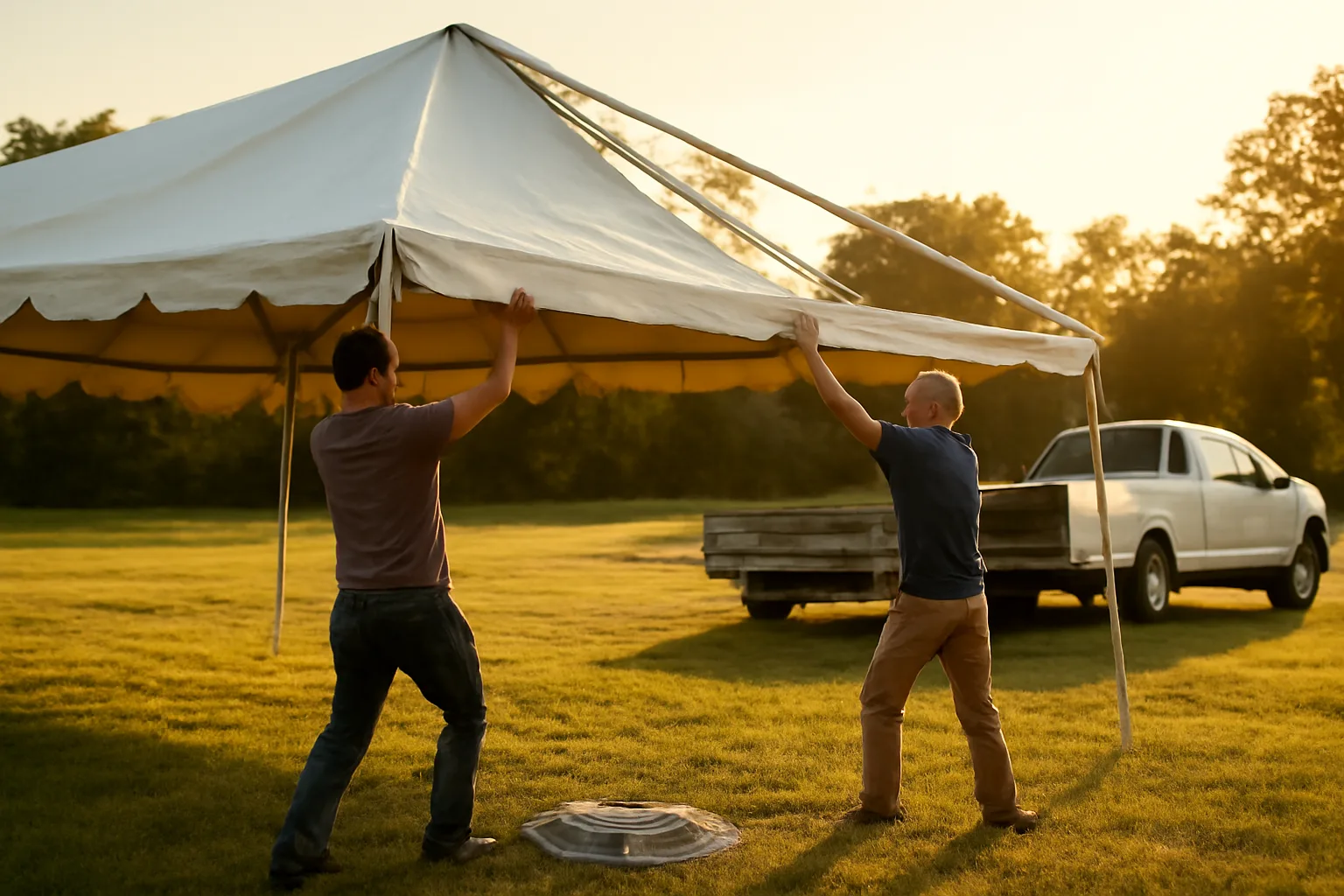
Tent rental is a local delivery and install trade. You store tents, haul them to a site you do not control, put them up, then take them down and invoice the host or the planner.
That is the product. Most shops also roll tables, chairs, sidewalls, and a dance floor on the same truck because the labor is already paid to be there. The U.S. Census Bureau parks a lot of this work in NAICS 532289, All Other Consumer Goods Rental, a class for establishments that rent consumer goods outside a short list of carve-outs. [12]
It is not camping retail. It is not a venue. You do not sell the tent. You sell a temporary structure that has to stand in wind. It also has to come off a lawn without a claim.
Fire officials care about membrane structures. Building officials care about temporary structures. Your revenue department cares that you rented tangible personal property. Those are three desks, and each one can shut down a Saturday if you ignore it.
If you only push pop-up canopies under the permit line, you may never meet a fire marshal. The minute you quote a 20x20 or a 40x60 wedding tent, you are in code land. Plan for that before you buy vinyl.
How do you start tent rental?
You start tent rental like any small trade, then you add the tent paper. Form an entity with your state. Get a free EIN from the IRS. Open a bank account that is not your personal checking. Register to collect sales tax if your state taxes rentals of tangible personal property. [5][6]
The SBA 10-step start guide covers the generic half (structure, financing, location, insurance). It will not tell you how to guy a 40-foot bay or who stamps a wind letter. Use it as a checklist, not a tent manual. [6]
Call three desks before you buy a pole. The city or county business license counter. The state department of revenue. The fire prevention office that actually issues tent permits.
There is no national tent-rental license, so stop looking for one. Most states issue a business registration, maybe a contractor class if you cross into structure work, and then job-by-job permits. Confirm form names with the board that owns them. I will not invent a fee or a wait time.
Buy used frame tents from a shop that can name the maker and still sell rafters. Frame beats pole for most first-year fleets. Two people can set a 20x20. You are not fighting a center pole in a backyard with a maple in the way.
Bind insurance before the first install. Then do a timed dry run in a field you control. Photograph every connection. That folder is your training guide.
Do you need a special license to rent tents?
You usually need a local business license and a tax registration. You usually do not need a special statewide tent rental charter. Confirm that with your city clerk and your state business portal, because a few places fold tents into contractor, amusement, or special-event promoter rules.
California is the example people cite first. Health and Safety Code section 13115 makes it unlawful to run certain tent assemblies for 10 or more people unless the fabric is nonflammable or kept flame-retardant. [4] That is a fabric and assembly rule, not a rental-company charter. You still register the shop like anyone else. If California is on your calendar, read the tent rental board in california notes, then confirm every current form with OSFM and your city.
Install large membrane structures and some building departments treat the work like temporary structure erection. They want a contractor class or a PE on the drawings. That is local. Read the adopted building code, not a Facebook group.
Sales tax registration is the license people forget. New York taxes the rental of tangible personal property. California's CDTFA publishes tax rules for leasing tangible personal property in Publication 46. Your state has an analog. Register before the first invoice. [9][14]
Employees trigger more paper: withholding, unemployment, and workers' compensation in almost every state. OSHA injury logs sit in 29 CFR 1904. Read 1904.1 and 1904.2 before you assume a small shop is out. [15]
What size tent needs a fire or building permit?
Most cities that adopted the International Fire Code require a permit before you erect a tent or membrane structure larger than 400 square feet. The 2021 IFC says, "Tents and membrane structures having an area in excess of 400 square feet shall not be erected, operated or maintained for any purpose without first obtaining a permit and approval from the fire code official." [1]
Read the exceptions in the edition your city adopted. Recreational camping tents are carved out. Open-sided tents have a different path, including a 700 square foot cap in the model exception if you also meet the clearance rules. Your adopted code is the one that matters, not the model book on my desk.
Building departments using the International Building Code also regulate temporary structures. The 2021 IBC requires a permit for temporary structures and uses that cover more than 120 square feet when 10 or more people gather, including connected spaces that share egress. [2]
Those two thresholds do not match. 120 and 400. An AHJ can enforce either or both. I have seen a 20x20 (400 square feet on the nose) argued both ways. Don't be the person arguing on the lawn. Ask the fire official in writing before you quote the job.
Cooking and open flame sit on their own rule. IFC Chapter 31 keeps open flame, charcoal, and similar devices out of the tent and generally 20 feet away unless the fire official approves otherwise. [1]
Generators, heaters, and exit signs show up as conditions on the permit, not as a separate license. Bring the site plan they ask for. Show exits, extinguishers, guy-out area, and the nearest hydrant if they want it.
| Trigger | Threshold | Who asks | Source |
|---|---|---|---|
| Tent or membrane structure | Over 400 sq ft | Fire official | 2021 IFC 3103.2 [1] |
| Open-sided model exception | Max 700 sq ft (plus clearances) | Fire official | 2021 IFC 3103.2 Exception [1] |
| Temporary structure, 10+ people | Over 120 sq ft | Building official | 2021 IBC 3103.1.2 [2] |
| Open flame or cooking device | Generally 20 ft from tent | Fire official | 2021 IFC Ch. 31 [1] |
What flame certificates do inspectors want to see?
You need a flame certificate that tracks to the actual tent, not a PDF you found online. The IFC requires, before a permit is granted, a certificate from an approved testing laboratory that the tent materials meet NFPA 701 Test Method 1 or 2, as appropriate. [1]
Keep that certificate in the truck and in your job folder. Inspectors ask for it on the wettest Saturday of June. If you cannot produce it, they can shut the install down.
California goes further. Health and Safety Code 13115 makes it unlawful to operate listed places of assemblage "in any tent, awning, or other fabric enclosure unless such tent, awning, or other fabric enclosure, and all auxiliary tents, curtains, drops, awnings and all decorative materials, are made from a nonflammable material or are treated and maintained in a flame-retardant condition" when 10 or more people may gather. [4] If you work there, confirm current listing rules with the Office of the State Fire Marshal. Processing and listing details change. I will not invent them.
Labels sewn into the valance help. They are not a substitute for the lab certificate. Some jurisdictions require re-treatment after repairs. Ask.
Sidewalls, liners, and draping are decorative materials. They get tested too. Don't throw fashion fabric on a wedding tent and hope.
What does first-year tent rental work actually look like?
First year is a calendar business wearing a construction costume. Weekdays are sales, site checks, and warehouse. Fridays and Saturdays are installs. Sundays are strikes. Monday is wet vinyl, bent rafters, and invoices.
You will underbid labor until you time a full cycle. A 20x40 frame with sidewalls is not an hour. It is load, drive, find the unmarked sprinkler heads, argue about the oak tree, stake, dress, reset a bay, get a signature, drive home, and unload. Budget the whole loop.
Weather runs you. Have a written wind policy and a cancel or postpone clause. If the AHJ or your PE letter names a take-down speed, that number goes in the contract. I would not take a job that forbids early strike when wind hits the letter.
Site visits save tents. Look at overhead lines, grade, underground utilities, and access for the truck. Call 811 before you drive stakes in places that require it. Photograph the lawn. Note irrigation. Get the contact who will be on site, not the planner who will be at brunch.
Hire slow. One reliable helper beats three cousins. Pay legally. Heat on a July install is an OSHA issue, not a toughness contest. OSHA's heat-exposure page is the federal baseline. Some states write their own outdoor-heat rules on top. [13]
How much money do you need to start tent rental?
Nobody has a clean national survey of tent-rental startup cost. Anyone quoting a single number is selling something. The honest range is wide because a used 20x20 frame and a trailer is a different business from a new 40x80 clearspan and a box truck.
What I would actually spend first: two or three workhorse frame sizes you can mix (20x20, 20x30, 20x40), matching sidewalls, enough stakes and ratchet straps to guy them properly, a trailer you can load without a forklift, hand tools, and a warehouse you can stand in rain. Buy from brands that still sell replacement parts.
What I would not spend first: a wrapped sprinter, a custom e-commerce site, a showroom, or a 60-foot structure you cannot staff. Those wait until the calendar is full.
Insurance, fuel, stake replacement, and Saturday overtime will outrun the tent payment if you price like a hobbyist. Track every mile. The IRS set the 2025 standard mileage rate for business use at 70 cents per mile. Confirm the current year rate on IRS.gov before you file. [8]
Entity filing fees are state-specific. Confirm with the secretary of state. I will not invent them.
If an AHJ wants a PE-stamped wind analysis, budget for an engineer who has done tents, not a cousin with CAD. TentStakePath sells a $179 one-time Wind-Load + Stamp Kit for operators who need that packet assembled. Use it or hire the PE direct. Either path is fine.
What insurance do you need to rent tents?
You want commercial general liability that names the venue and the host as additional insureds when they ask. You want inland marine or a floater on the tents, because CGL does not replace a stolen 20x40. You want auto on every vehicle and trailer combo. If you have employees, you want workers' comp. If you have none, some venues still require an alternative.
I will not quote premiums. They move with claims, county, and whether you do high-wind coastal work. Get numbers from a licensed agent who has other rental accounts. Bring your contract and your wind policy to that meeting.
Certificates of insurance are operational paper. Learn to issue them the same day. A job dies if the country club does not have the cert by Thursday.
Read the exclusions for wear, mysterious disappearance, and off-premises property. Tents live off-premises. That is the point.
Some municipalities want to be additional insured on the permit. Build that into your quoting time.
Do tent trucks and trailers need a USDOT number?
If you operate a vehicle in interstate commerce at 10,001 pounds GVWR or more, FMCSA says you need a USDOT number. Their registration page states you need one if the vehicle "has a gross vehicle weight rating or gross combination weight rating, or gross vehicle weight or gross combination weight, of 10,001 pounds or more" and is used in interstate commerce. Hazardous materials have a separate trigger. [7]
A one-ton dually plus a loaded tent trailer crosses that line faster than people think. Weigh the combination. Don't guess.
Intrastate-only shops follow state motor carrier rules, which may still want a USDOT number or a state equivalent. Confirm with your state DOT. I will not invent the form.
CDL depends on GVWR and air brakes, not on "I only go 40 miles." Read FMCSA and your DMV, not a forum.
Overwidth loads (some clearspan packages) need state permits. Those are trip-based. Confirm with the state permit desk.
How should you price a tent rental job?
Price the loop, not the vinyl. Delivery zone, install hours, strike hours, wall counts, surface (asphalt needs weights, which are slower), weekday versus Saturday, and how far the truck sits from the stakes.
I use a floor: labor at a fully loaded shop rate, plus mileage at something above the IRS rate so fuel and wear are not a donation, plus a tent-day rate that pays the asset back in a season count you can defend. Then I add a weather buffer.
Don't match the cheapest 20x20 on a Facebook group. That person is liquidating.
Publish a damage schedule. Stakes left in a lawn, burned vinyl from a patio heater, and a torn sidewall have prices. Put them in the contract before the party.
Deposits should cover the Saturday you cannot resell. I like a number that hurts if they flake, not a token.
Sales tax sits on top if your state taxes the rental. Don't eat it. [9][14]
What mistakes shut down first-year tent jobs?
Skipping the permit because it is only a backyard. The IFC threshold is 400 square feet, and a 20x20 is exactly that. [1] The neighbor who called the fire desk does not care that you are new.
No flame certificate in the truck.
Stakes through irrigation and unmarked utilities. Call 811. Photograph.
No wind clause. You leave a tent up in a front that your letter does not support, or you strike and the host wants a full refund plus flowers.
Uninsured helpers paid cash. That is how you fund someone else's lawyer.
Heat illness on a shadeless July install. OSHA is not theoretical when someone goes down. [13]
ADA is the one planners forget. If the event is open to the public, accessible routes still matter. The 2010 ADA Standards are the federal design baseline for accessible routes and assembly areas. A tent in the middle of a lawn with a 4-inch lip and no firm path is a problem for more than the inspector. [11]
OSHA egress rules for workplaces still apply to your crew. 29 CFR 1910.36 sets exit-route design rules. Your fire permit will also dictate exit counts and widths. Follow the stricter paper. [10]
Which office do you call before you quote a state?
Call the fire prevention bureau that owns the job site, then your state's business and tax desks. The tent rental board is almost never a single board. It is a stack.
Start with the state pages that map the local stack, then confirm every fee on the phone. Florida work goes through a different fire-prevention and business-tax stack than California. Use the tent rental board in florida page as a directory, then confirm. Arizona, Colorado, and Georgia each split licensing, tax, and fire in their own way (tent rental board in arizona, tent rental board in colorado, tent rental board in georgia).
Building a multi-state calendar? Add tent rental board in alabama, tent rental board in hawaii, and tent rental board in connecticut to the call list before you quote those jobs. Hawaii's shipping and flame rules are not mainland rules. Connecticut is dense with local fire districts.
Confirm with the relevant board. No article, including this one, can promise an approval or a timeline.
What is a waste of money in year one?
Skip the national franchise pitch. This is a local staking business.
Skip custom software in year one. A shared calendar, a paper checklist, and invoices that actually go out will beat a half-built app.
Skip the giant clearspan until you have a crew that can set a 20x40 in the rain without calling you.
Skip marketing retainers from people who have never stood under a ridge. Your first 20 jobs come from planners, venues, and other rental shops that are overbooked. Go there in person.
Do spend on stakes, base plates, and ballast that match the soil and the wind letter. Cheap stakes are how tents walk.
Do spend on a lawyer to mark up your rental contract once. Wind, damage, payment, and early strike belong in writing.
Want the wind-load packet without assembling it from scratch? The Wind-Load + Stamp Kit on /start is the only product path I will point at. TentStakePath is an independent publisher, not a law firm and not a service company. The rest of this page still works if you never click that.
Frequently asked questions
What is tent rental?
Tent rental is a local trade that stores, delivers, installs, and later removes tents for events. Most shops also rent tables, chairs, and sidewalls on the same run. Census NAICS 532289 covers a large share of consumer-goods rental of this type. You are selling a temporary structure, not a campsite and not a venue.
How do you start tent rental?
Form a state entity, get a free IRS EIN, open a business bank account, and register for sales tax if your state taxes rentals. Then call your city license desk and the fire official who issues tent permits. Buy a small used frame fleet you can still get parts for. Bind insurance before the first install. Confirm every local form. There is no national license.
Is there a national tent rental license?
No. The federal layer is tax (EIN), workplace rules (OSHA), vehicle rules (FMCSA if you hit 10,001 pounds interstate), and accessibility if the event is public (2010 ADA Standards). Fire permits, business licenses, and sales-tax accounts are state and local. Confirm names and fees with the board that owns the form.
What size tent needs a fire permit?
Under the 2021 International Fire Code, tents and membrane structures larger than 400 square feet need a permit and fire-official approval, with listed exceptions (camping tents, and some open-sided tents up to 700 square feet). Your city may have adopted a different edition or a tighter local rule. Ask that official in writing before you quote.
What is NFPA 701 and why do inspectors ask for it?
NFPA 701 is the flame-propagation test the International Fire Code points to for tent and membrane fabrics. Before a permit, the IFC wants a certificate from an approved lab that the actual materials meet Test Method 1 or 2. Keep that certificate with the tent. A sewn-in label helps but does not replace the lab paper.
Do I need a USDOT number for a tent trailer?
You need a USDOT number if the vehicle is used in interstate commerce and the GVWR, GCWR, GVW, or GCW is 10,001 pounds or more, per FMCSA. A loaded one-ton and trailer often crosses that line. Intrastate-only fleets follow state motor carrier rules, which may still want a number. Weigh the combo and confirm with FMCSA or your state DOT.
Is tent rental taxable?
Often yes. Many states tax the rental of tangible personal property. New York taxes rentals of tangible personal property. California covers leasing of tangible personal property in CDTFA Publication 46. Register with your revenue department before the first invoice and do not eat the tax to win a bid. Confirm the current rate and any exemption certificates locally.
Can I cook under a rental tent?
Usually not without fire-official approval. IFC Chapter 31 keeps open flame, charcoal, and similar cooking devices out of the tent and generally 20 feet away unless the official says otherwise. If a caterer wants a cook tent, plan a separate permitted unit with the clearances your adopted code names. Don't improvise on the lawn.
Do I need a PE stamp for tent wind loads?
Sometimes. Plenty of backyard 20x20 jobs never see an engineer. Larger membrane structures, tight urban sites, and picky AHJs often want PE-stamped calculations tied to the actual product and the site. Confirm with the building or fire official on that job. Don't invent a wind number from a catalog photo.
How many people do I need to set a 20x40?
Two skilled people can set a 20x40 frame on a clean lawn if the truck is close and you are not hanging a full dress. Add a third for sidewalls, lights, bad grade, or a long carry. Time a full cycle once (load through unload) before you quote Saturday labor. First-year shops almost always undercount the loop.
What insurance should I buy first?
Bind general liability, auto (including trailers), and an inland-marine floater on the tents before the first install. Add workers' comp when you have employees, and sometimes sooner if a venue demands it. I will not quote a premium. Ask a licensed agent who already writes rental shops, and learn to issue additional-insured certificates the same day.
Can I start tent rental from my driveway?
Some towns allow a home-occupation or home-based warehouse. Many do not once trailers, forklifts, or Saturday staging show up. Ask zoning and the fire inspector who would see the storage, more than the event site. Neighbors call. Have a written answer on parking, hours, and flame-certified fabric storage before you stack poles at the curb.
What is the IBC 120 square foot rule?
The 2021 International Building Code requires a permit for temporary structures and uses covering more than 120 square feet when 10 or more people gather, including connected spaces that share egress. That is tighter than the IFC's 400 square foot tent trigger. Your building official may enforce IBC, IFC, both, or a local amendment. Ask before you price.
Do pop-up canopies count as tent rental?
They count as a rental product. They often sit under fire-permit thresholds if each unit stays small and open-sided, but clustered canopies can add up under IFC aggregate rules. Flame certificates still matter when an official asks. If pop-ups are your whole shop, you still need the entity, tax account, and insurance. The code path is just quieter.
Sources
- ICC, 2021 International Fire Code Chapter 31: IFC requires a permit for tents and membrane structures over 400 square feet, points fabric to NFPA 701, lists open-sided exceptions including a 700 sq ft cap, and restricts open flame near tents.
- ICC, 2021 International Building Code Chapter 31: IBC 3103 requires a permit for temporary structures over 120 square feet used for gatherings of 10 or more people.
- California Health and Safety Code section 13115: California makes it unlawful to operate listed tent assemblies for 10 or more people unless fabric is nonflammable or maintained flame-retardant.
- IRS, Apply for an Employer Identification Number (EIN) Online: New businesses can obtain an EIN from the IRS, which is the standard federal tax ID used to open accounts and file.
- U.S. Small Business Administration, 10 steps to start your business: SBA publishes a 10-step checklist covering entity, licenses, financing, location, and insurance for new firms.
- FMCSA, Do I need a USDOT number?: A USDOT number is required for interstate vehicles with GVWR, GCWR, GVW, or GCW of 10,001 pounds or more.
- IRS, Standard mileage rates: The IRS set the 2025 standard mileage rate for business use at 70 cents per mile.
- OSHA, 29 CFR 1910.36 Design and construction requirements for exit routes: Federal workplace rules set design requirements for exit routes that apply to crews and occupied work areas.
- U.S. Department of Justice, 2010 ADA Standards for Accessible Design: The 2010 ADA Standards are the federal design baseline for accessible routes and assembly areas at public events.
- U.S. Census Bureau, NAICS 532289 All Other Consumer Goods Rental (2022): NAICS 532289 covers establishments primarily engaged in renting consumer goods outside listed carve-outs, the class often used for party and tent rental.
- OSHA, Heat exposure: OSHA publishes federal heat-exposure guidance that applies to outdoor install labor.
- California CDTFA, Publication 46 Leasing of Tangible Personal Property: California publishes tax rules for leases and rentals of tangible personal property.
- OSHA, 29 CFR 1904.1 Partial exemption for employers with 10 or fewer employees: OSHA recordkeeping in Part 1904 applies to employers, with a partial exemption described in 1904.1 that must be read with 1904.2.