Last updated 2026-08-19
TL;DR
Tent rental is short-term hire of pole, frame, or clearspan tents plus crew and ballast. Start with a legal structure, a free EIN, local registration, and treat each install as a permitted temporary structure. Model fire code requires a permit for tents over 400 square feet. Year one is records, insurance, flame certificates, and turning down jobs your inventory cannot hold in wind.
What is tent rental?
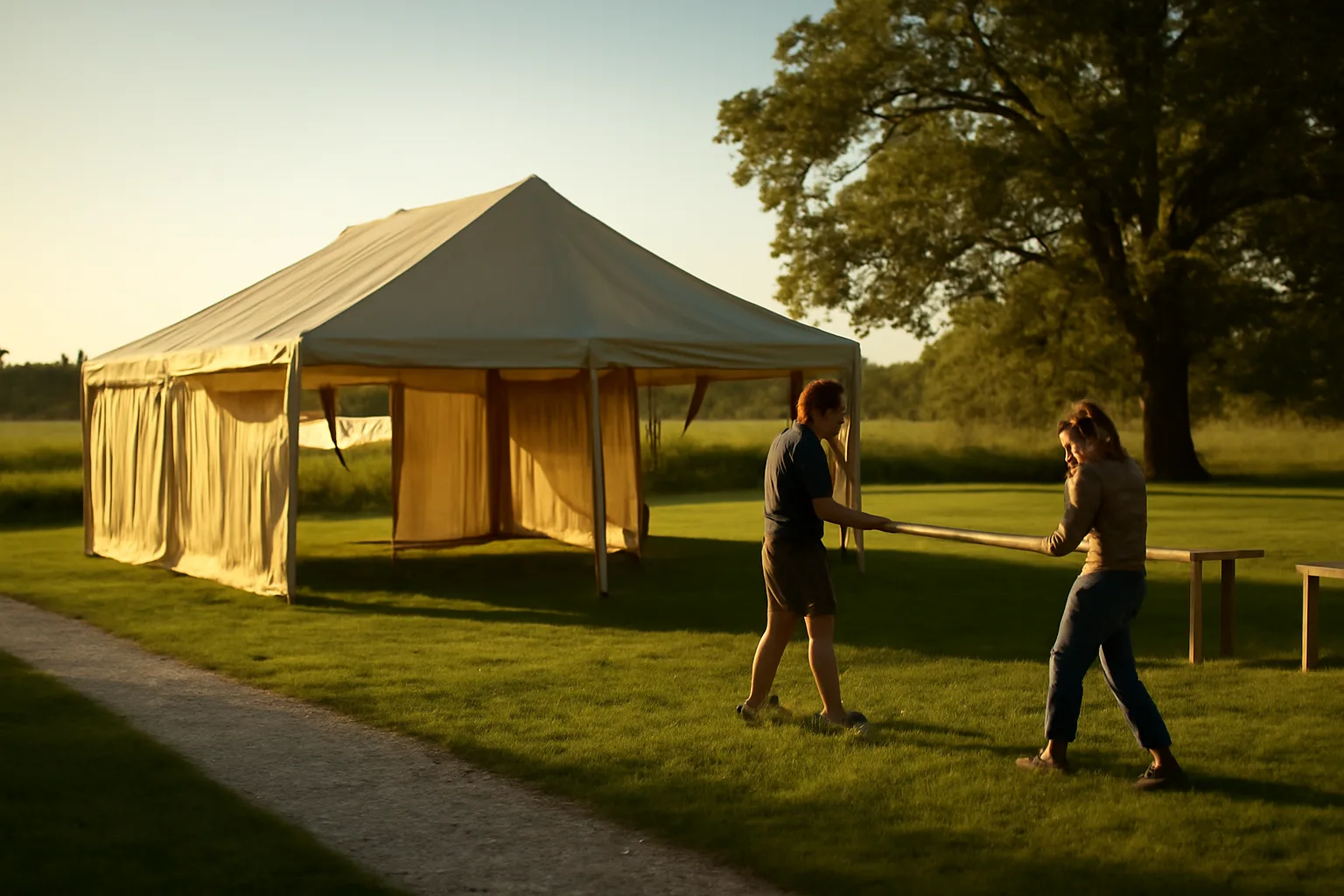
Tent rental is the short-term hire of a membrane structure and the crew that puts it in the ground. You rent pole tents, frame tents, or clearspan structures, plus stakes or ballast, sidewalls, and often a floor. You take it down after the date. That is the whole trade.
You are not selling a party. You are parking a temporary building on someone else's dirt. The Census Bureau files most shops like this under NAICS 532289, All Other Consumer Goods Rental, the same bucket that holds party-supply rental [8]. The code is for statistics. It is not a license and it will not get you past a fire marshal.
Wedding photos drive the search traffic. Commercial and municipal work (commencements, festivals, job-site cover, overflow seating) is what pays when Saturday washes out. I would rather book two flat corporate installs than one 40x100 on a slope with no water truck and a planner who found the property line at 4 p.m.
Bill the fabric, the install window, the radius, and the add-ons as separate lines. Heat, light, and dance floor do not belong inside a blended “package” if you ever want to see where your labor went. A box-store pop-up in a backyard is not this business. Charge a fee for a rope-and-pole tent over tables, and you are already in fire-code land.
How do you start tent rental?
You start on paper, not on a Marketplace listing. Pick a legal structure, apply for a free EIN from the IRS, register the entity and any trade name where you actually operate, open a bank account that is not your rent account, then buy only the inventory you can permit, insure, and install with the crew you have [2][3][4][15].
The SBA launch pages are dull on purpose. Structure first. Registration second. Tax IDs third. Local licenses after that [3][4][15]. Tent work adds a stack those pages do not write for you: flame certificates, site permits, anchorage plans, and, for larger frames, engineered drawings.
I would not buy a 40x60 until I had a written insurance quote, a dry place for wet vinyl, and a truck that stays under the CDL line unless I already hold the license. Used tops with no NFPA 701 paper are a waste of money. You cannot permit them in a city that reads the code.
Make the first paying job small, flat, and close. You are testing pull-out and a weather call, not a brand story. Then keep records like a person who expects an audit and a wind claim in the same season.
Do you need a license to rent tents?
Yes. You almost always need a local business license or tax certificate, and you usually need a state sales-tax permit before you invoice. A single national “tent rental license” does not exist. Confirm the exact name and the fee with your city clerk and your state revenue department. Do not take a fee or a wait time from a blog.
The SBA tells you to register with state and local government because that is where the rule lives [3]. Some states also want a seller’s permit in hand before you collect tax on a rental. A handful of contractor boards treat tent erection as construction once you leave the party-rental box and start building membrane structures over assembly occupancies. Ask the board, in writing, whether temporary tent installation is in scope. If they say yes, you pull that card before you sell a 40x100.
Home-occupation rules matter if poles live on a residential lot. Neighbors complain about stake crews at 5 a.m. Zoning shuts more first-year shops than fabric quality does.
Sales tax follows the tent in most states because the tent is tangible personal property. California’s Publication 46 states that tax applies to leases of tangible personal property in that state, which is the pattern you should expect until your own revenue department says otherwise [9]. A few states treat optional install labor differently from the fabric. Invoice the way the state told you to invoice.
Renewal is a local calendar, not a national myth. Packets in California do not match packets in Florida. If you cross state lines, read the state pages first, including tent rental renewal in california and tent rental renewal in florida, then confirm with the board that cashes the check.
What permits do event tents need on site?
The fire code official and the building official can both require a permit for the same tent. Under the 2021 International Fire Code, “Tents and membrane structures having an area in excess of 400 square feet (37 m2) shall not be erected, operated or maintained for any purpose without first obtaining a permit and approval from the fire code official.” [1]
Four hundred square feet is a 20x20. A lot of “small” wedding tents are already over that line. The 2021 International Fire Code is the model most states and cities adopt, often with local amendments. The amendment is what shuts you down at 2 p.m. on Friday.
The 2021 International Building Code is tighter on some jobs. Temporary structures over 120 square feet that gather 10 or more people need a permit from the building official [10]. A 10x20 lounge tent at cocktail hour can trip it. IFC and IBC exceptions exist (open-sided tents at a higher area, recreational camping tents). Do not memorize exceptions from memory. Open the adopted code in the event city.
Cooking under canvas, enclosed sidewalls, occupancy load, exits, and no-smoking signs all ride on the same permit. I pull the tent permit or I decline the job. Clients who “will handle it” often will not.
Permit fees are local. Confirm with the fire prevention bureau. I will not invent a number.
| Rulebook | Trigger | Who signs |
|---|---|---|
| 2021 IFC 3103.2 | Tent over 400 sq ft | Fire code official |
| 2021 IBC 3103.1.2 | Temp structure over 120 sq ft, 10+ people | Building official |
| 49 CFR 383 | Vehicle GVWR of 26,001 lb or more | CDL via state DMV |
| IRS EIN | Hiring, most entities, many filings | IRS, no fee |
What fire and fabric rules apply to rental tents?
Event tents are not camping tents. The membrane has to meet flame propagation criteria. The 2021 IFC sends you to NFPA 701 Test Method 1 or Test Method 2 for that fabric [1]. If the prior owner “thinks it was certified,” that is not a certificate.
Keep the manufacturer’s affidavit or the lab report with the tent. Inspectors ask on site. A faded label in the valance helps. A PDF on your phone helps more. Sidewalls, liners, and drape get the same question. Cheap untested drape is how clean jobs fail inspection.
Anchorage is not a suggestion. IFC Chapter 31 requires tents to be adequately roped, braced, and anchored to withstand the elements [1]. Stakes fail in sand, fill dirt, and wet clay. Water barrels that look heavy in photos are often light for a frame tent in a thunderstorm. I would rather lose the deposit than guess ballast on a 40x60.
Cooking, heaters, and generators have separation rules in the same chapter. If you do not rent those items, say so in the contract so nobody claims you approved a taco truck under the eave.
Do tent rentals need engineered wind-load drawings?
Often, yes, once the tent is large, enclosed, or standing in a jurisdiction that actually reads IBC Chapter 16. The IBC points wind design at ASCE 7 [13]. A sales flyer with a “wind rating” is not an engineered drawing.
A licensed professional engineer stamps either a site-specific package or a manufacturer installation manual tied to a product line. Inspectors in coastal counties and mountain towns ask for that stamp. Pole tents are not exempt from physics. They just fail stakes first.
I would not buy a clearspan without a path to stamped drawings. Confirm with the building official whether they want site calcs or a manufacturer PE manual. Do not promise a client an approval date. Boards do not work on your Saturday.
If you need a clean packet to take to an engineer, TentStakePath sells a $179 one-time Wind-Load + Stamp Kit. Hire the PE either way. The stamp comes from a licensee in the state of the job, not from a website.
How much does it cost to start tent rental?
Nobody has a clean national number. Inventory dominates, and a used 20x20 frame package is a different planet from a new 40x100 clearspan with walls and a floor. I will not invent a “typical startup cost.” Anyone who quotes one number for the whole country is selling something.
Year-one cash actually goes to tents and plates, a trailer or box truck, stake kits, storage that can dry wet vinyl, insurance, and the permit float (you pay the city before the client pays you). Cheap tents with no 701 paper are a waste. Fancy scheduling software in month one is a waste.
Labor is the silent line. Two people and a 20x30 is a Saturday. A 40x80 with cathedral windows is a full crew, tall ladders or a lift, and a weather call you are willing to make. Hold cash for the first ruined top. Vinyl meets a knife on a stake pocket. It happens.
If a broker sells you a turnkey “territory,” walk. This is not a franchise unless you were handed a real franchise disclosure document.
What insurance do tent rental companies carry?
You carry commercial general liability, and you will be asked for additional-insured endorsements on almost every venue. An inland marine floater covers tents that live on other people’s lawns. Auto, including hired and non-owned if staff use personal trucks. Workers’ compensation once you have employees, which is a state statute, not a preference.
I will not quote a premium. Markets move. A shop that installs 20x20s is not a shop that builds festival compounds.
Venues often ask for $1 million per occurrence. That is a contract habit, not a statute. Read the exhibit. Some cities want to sit on the policy before they issue the fire permit.
Weather is not fully insurable the way new operators hope. Your contract should say who calls a blow-down, who pays a dry run, and what happens if the marshal kills the install at noon. That paragraph is worth more than lettering on the trailer.
How do EIN, sales tax, and income tax work?
Get the EIN yourself on IRS.gov. The Service says, “Applying for an EIN is a free service offered by the Internal Revenue Service.” [2] If a website charges you for that number, you are being played.
Sole proprietors report on Form 1040 Schedule C [12]. Partnerships and S corporations use different forms. The SBA walks through federal and state tax IDs [15]. State income tax and sales tax are separate animals. Confirm both.
Most states tax the rental of the tent as tangible personal property. California’s Publication 46 is the clearest public example that leases of that property are generally taxable [9]. Labor to install may be taxable or not, depending on whether it is optional and how you write the invoice. Ask the state in writing.
IRS Publication 583 is the recordkeeping book I want new operators to open. Keep the records that support income and deductions for as long as the limitation period stays open [11]. Open a dedicated account. Pay yourself on purpose. Grocery charges in the tent account are how Schedule C becomes a weekend with a shoebox.
What truck and labor rules apply to tent rental?
If the truck (or the rated combination you are actually operating) hits a GVWR of 26,001 pounds or more, you are in commercial-driver territory under 49 CFR 383 [5]. Plenty of operators stay in lighter box trucks on purpose. A 26-foot box looks productive until you need a qualified driver every Saturday in June.
Ratings live on the door sticker, not on the dealer invoice. A trailer plus a one-ton can sneak over the line.
Employees are employees. DOL Fact Sheet 13 is the federal reminder that job titles do not decide the employment relationship [14]. If you control the install, set the hours, and they only exist on your jobs, treat them as employees. That means wage and hour rules, and it means workers’ comp in most states.
OSHA 1910.132 requires PPE when hazards are present [6]. Steel toes, eye protection, and gloves are not theater. Stake-driving and frame ears will prove it.
Public events can trip ADA Title III duties for the venue, and sometimes for the layout you sold, including access to a floor you rented [7]. You are not the Department of Justice. You can still lose the job if your floor blocks the only accessible route.
What paper should you keep in year one?
Keep four piles. Pile one is the company: articles or DBA, EIN letter, local business license, sales-tax permit, insurance policies, additional-insured forms, driver licenses, and I-9s if you hire. Pile two is the inventory: purchase invoices, NFPA 701 certificates, repair logs, retirement dates for scarred tops. Pile three is the job: signed contract, site photos, stake or ballast plan, fire and building permits, PE drawings if required, weather notes, change orders. Pile four is the money: invoices, deposits, city receipts, 1099s, mileage, Schedule C support.
IRS Publication 583 is the federal baseline for how long that last pile lives [11]. I number tents. I do not trust memory after a holiday weekend.
Contracts should say who pulls the permit, who calls weather, what the site must provide (utility mark-outs, a firm pad, water for barrels), and when the balance is due. If you do not collect a deposit, you will eat weekends for free.
For state renewal calendars, use the state guides and then call the board. Start with tent rental renewal in arizona, tent rental renewal in colorado, tent rental renewal in georgia, and tent rental renewal in alabama if those are your maps. Add tent rental renewal in connecticut and tent rental renewal in idaho when you work those counters. Confirm every fee. Never treat a publisher’s page as the invoice.
If you want a single place to line up the wind-load packet after the licenses, go to /start. TentStakePath is an independent publisher, not a law firm and not a service company. We do not approve permits and we do not quote board timelines.
What should you skip in the first year?
Skip the 40x100 you cannot staff. Skip lead mills that sell you a vinyl cutter and a “national” website. Skip heating a clearspan you have never winterized. Skip verbal contracts. Skip storing wet tops.
Buy a moisture meter before you buy a neon sign. Molded vinyl is a write-off.
I would skip most software until you have 30 jobs and hate your spreadsheet. I would not skip a dedicated phone number or a written blow-down rule.
If a client wants a tent on a deck, a roof, or a pool cover, that is an engineering job. Walk or bring the PE. Your gut is not a load combination.
Frequently asked questions
What is tent rental?
Tent rental is short-term hire of pole, frame, or clearspan tents plus install labor, stakes or ballast, and often walls or a floor. You put a temporary structure on a site and remove it after the event. The Census Bureau usually counts this work in NAICS 532289. It is a permit-and-liability trade, not a party-planning hobby.
How do you start tent rental?
Pick a legal structure, get a free EIN from the IRS, register locally, open a dedicated bank account, then buy inventory you can insure and permit. Add flame certificates and a site-permit plan before the first 20x20 that charges a fee. Confirm licenses with the city and any contractor board. Do not start by buying the largest tent you can finance.
Do I need a contractor license to install rental tents?
Sometimes. Many shops operate on a business license and a sales-tax permit. Some states treat tent erection over assembly occupancies as specialty construction. Ask the contractor board whether temporary membrane structures are in scope. Confirm any fee and any exam with that board. A publisher cannot answer that for your county.
How big a tent needs a fire permit?
Under the 2021 International Fire Code, tents over 400 square feet need a permit and approval from the fire code official. That is a 20x20. The 2021 IBC can require a building permit at 120 square feet when 10 or more people gather. Always open the code the event city actually adopted, including local amendments.
Is tent rental taxable?
In most states, yes, because you are renting tangible personal property. California’s Publication 46 is a clear public example that leases of that property are generally subject to tax. Install labor may be treated differently if it is optional. Get the written rule from your revenue department and invoice the way they told you to invoice.
Do I need a PE stamp for rental tents?
For small open pole tents in a relaxed town, maybe not. For large frames, enclosed tents, coastal wind, or any inspector who reads IBC Chapter 16 and ASCE 7, yes. A brochure wind number is not a stamp. Confirm with the building official whether they want site-specific calcs or a manufacturer PE manual.
What is NFPA 701 and why do inspectors ask?
NFPA 701 is the flame-propagation test the 2021 IFC points to for tent and membrane fabric. Inspectors want the certificate or manufacturer affidavit, not a verbal claim. Untested sidewalls and drape fail as often as the top. Keep a PDF with each asset and a label on the valance.
Can I run tent rental as a sole proprietor?
Yes. Many first-year shops do, and they file Schedule C with Form 1040. You still need the local licenses, the sales-tax permit, and insurance. An LLC or corporation can wait until a lawyer and an accountant say the liability or tax math changed. Confirm entity rules with your state filing office.
How long should I keep tent rental invoices and permits?
Follow IRS Publication 583. Keep records that support income and deductions until the limitation period on that return runs out, which is often three years and longer in some cases. Keep 701 certificates and PE drawings for the life of the tent. Keep job permits with the contract. Number your tops so the file matches the vinyl.
Do tent installers need a CDL?
Only if they operate a commercial motor vehicle in the federal sense. Under 49 CFR 383, a single vehicle with a GVWR of 26,001 pounds or more is a Group B problem. Many shops stay under that line on purpose. Read the door sticker, not the sales brochure. Confirm endorsements with your state DMV.
What insurance limits do venues ask tent companies for?
Venues commonly ask for $1 million per occurrence on general liability plus additional-insured wording. That is a contract habit, not a statute. Some cities want to be named before they issue a fire permit. Get a written quote before you buy inventory. I will not invent a premium.
Should I buy used tents in year one?
Buy used only with NFPA 701 paper, intact plates, and a top you can inspect in daylight. Orphaned vinyl with no certificate is a waste, because serious cities will not permit it. Budget for drying space. A cheap wet top that molds is not a bargain. I would skip mystery clearspans with no path to a PE stamp.
Who pulls the tent permit, the rental company or the client?
Either can, but you live with the result. I pull it or I decline the job, because a client who “will handle it” often shows up with no permit at 2 p.m. Write the duty into the contract. Confirm fees and lead times with the fire prevention bureau for that city. Nobody can guarantee a turnaround.
What is the first-year paper stack for tent rental?
Entity papers, EIN letter, local license, sales-tax permit, insurance and additional-insured forms, 701 certificates, numbered inventory, signed contracts, site photos, stake or ballast plans, fire and building permits, and the Schedule C file. Add PE drawings when the official asks. Confirm state renewal on the board’s form, not on memory.
Sources
- ICC International Fire Code 2021, Chapter 31: Tents over 400 square feet require a fire-code permit; fabric must meet NFPA 701; tents must be anchored.
- IRS, Apply for an Employer Identification Number (EIN) Online: Applying for an EIN is a free service offered by the IRS.
- U.S. Small Business Administration, Register your business: New businesses register with state and local government; rules and names of licenses are local.
- U.S. Small Business Administration, Choose a business structure: Legal structure (sole prop, partnership, LLC, corporation) is chosen at launch and changes tax and paperwork.
- eCFR, 49 CFR 383.91 Commercial motor vehicle groups: Group B covers any single vehicle with a GVWR of 26,001 pounds or more.
- OSHA, 29 CFR 1910.132 Personal protective equipment: Employers must provide and require PPE when workplace hazards are present.
- U.S. Department of Justice, ADA Title III regulations: Title III covers public accommodations and can affect accessible routes at public events.
- U.S. Census Bureau, NAICS 532289 All Other Consumer Goods Rental (2022): NAICS 532289 includes establishments that rent consumer goods such as party supplies.
- California CDTFA, Publication 46 Leasing of Tangible Personal Property: California generally taxes leases of tangible personal property, the category that includes rented tents.
- ICC International Building Code 2021, Chapter 31 Special Construction: Temporary structures over 120 square feet used to gather 10 or more people require a building permit.
- IRS Publication 583, Starting a Business and Keeping Records: Business records that support income and deductions must be kept until the limitation period expires.
- IRS, About Schedule C (Form 1040): Sole proprietors report business profit or loss on Schedule C.
- ICC International Building Code 2021, Chapter 16 Structural Design: Wind loads on structures are determined using ASCE 7 as referenced by the IBC.
- U.S. Department of Labor, Fact Sheet 13 Employment Relationship under the FLSA: The employment relationship under the FLSA depends on the facts of control and economic reality, not job titles.
- U.S. Small Business Administration, Get federal and state tax ID numbers: Businesses obtain federal and state tax ID numbers as part of launch.