Last updated 2026-08-19
TL;DR
Tent rental is short-term hire of membrane structures and event gear. There is no national license. You form an entity, get a free IRS EIN, register sales tax if your state requires it, buy insurance, and learn the local fire permit path. The 2021 International Fire Code triggers permits above 400 square feet. Confirm every form with the AHJ.
What is tent rental?
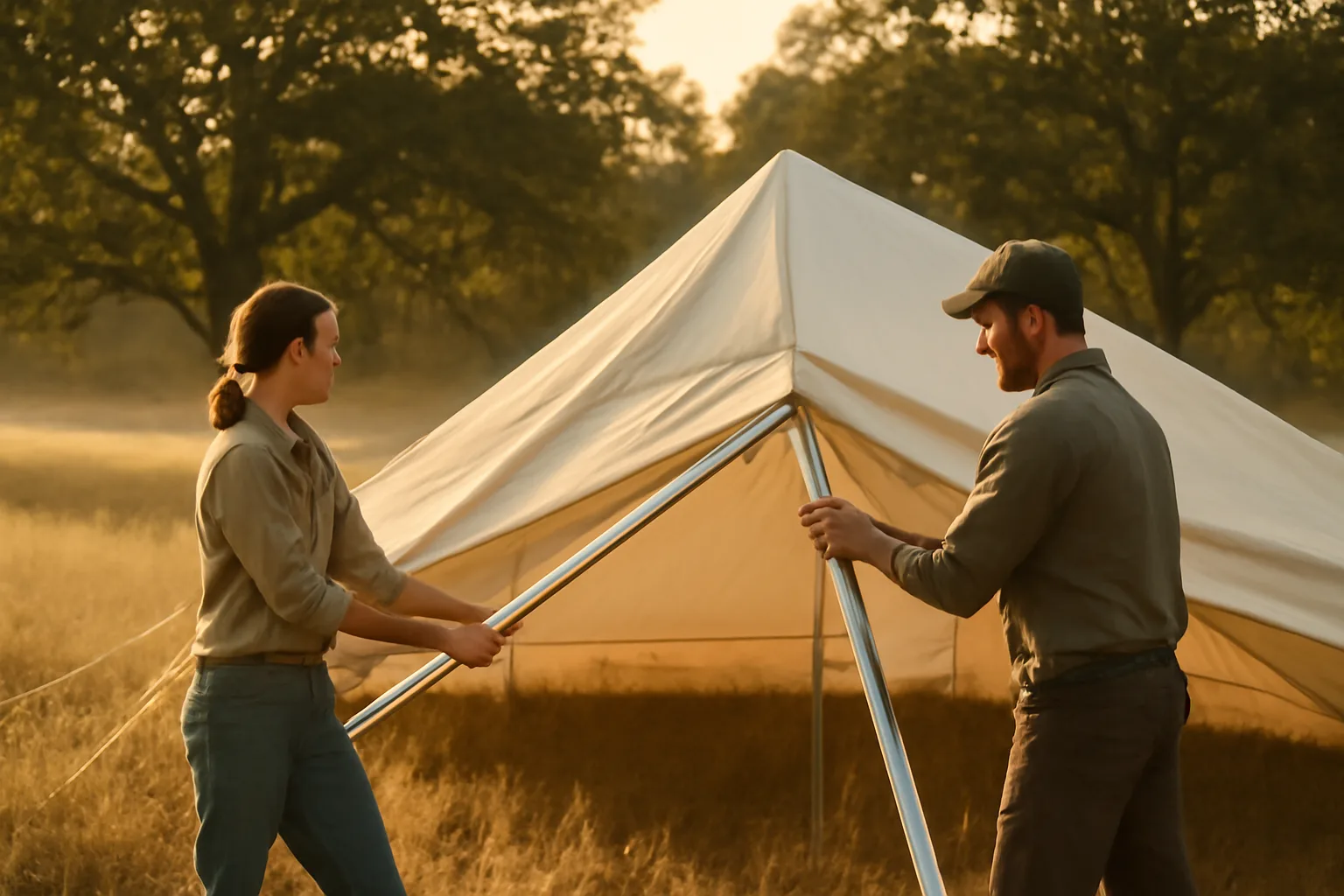
Tent rental is the short-term hire of membrane structures and the gear that makes them usable. That means frame, pole, tension, or clearspan tents, plus walls, liners, lighting, ballast or stakes, flooring, and often tables. You install a temporary building. Then you take it back.
You are not running a camping shop. Retail pop-up sales and glamping lodges are different trades. Commercial event work is install, weather, exits, and paper.
A lot of party and event shops land in NAICS 532289 (All Other Consumer Goods Rental) when they rent consumer event goods. The Census Bureau describes that industry as establishments primarily engaged in renting consumer goods outside a short list of exceptions.[12] Mixed yards sometimes sit under a general rental center code instead. Use the code your accountant files. Do not invent one for a grant form.
The job is physical. It is also a code job. A farm wedding still has a fire official, a wind forecast, and a stake pattern. Treat the inventory like poles in a shed and you will get red-tagged.
Structure type changes the engineering. A small straight-leg canopy at a market is not a 40 by 60 frame with cathedral windows. Permit triggers follow area and use, not brand names. I would not start by buying every size. Learn one county's packet first. Then buy the two sizes that county actually books.
How big does a tent have to be before you need a permit?
The 2021 International Fire Code requires a permit for tents and membrane structures larger than 400 square feet, with a narrower exception for some open-sided tents up to 700 square feet.[1]
That 400 square foot line is the number most fire inspectors carry in their head. A 20 by 20 is 400 on the nose. Many officials still want a permit at 400. Do not argue geometry on the lawn.
The code text is blunt. IFC Section 3103.2 says: "Tents and membrane structures having an area in excess of 400 square feet (37 m2) shall not be erected, operated or maintained for any purpose without first obtaining a permit and approval from the fire code official."[1]
Open-on-all-sides tents can get a 700 square foot exception if they also keep a 12 foot clearance to other tents and buildings, and if the clustered area stays under 700. Recreational camping tents are carved out. Your wedding sailcloth is not camping.
Building departments use a different book. The 2021 International Building Code requires a permit for temporary structures covering more than 120 square feet, with assembly-use wrinkles on top.[2] Fire and building can both show up. If they conflict, the stricter field rule wins that day.
| Rule book | Area trigger | What it usually means |
|---|---|---|
| IFC 2021 3103.2 | Over 400 sq ft | Fire permit before you erect |
| IFC open-sided exception | Up to 700 sq ft, plus 12 ft clearance | Possible skip, still confirm |
| IBC 2021 3103 | Over 120 sq ft temporary structure | Building permit can still apply |
Cities adopt different editions and write amendments. Confirm the adopted book with the fire prevention bureau. A Facebook group is not a source on this.
How do you start tent rental?
You start tent rental by building a legal shell, then a permit habit, then inventory. Entity first. EIN second. Sales tax and a local business license third. Insurance before the first deposit. Flame certificates and a site checklist before the first install.
There is no federal tent rental license. The SBA launch pages are still the right skeleton. Pick a structure, register the name, get tax IDs, then add the licenses your city and state actually issue.[4][5]
I would form an LLC in the state where you live and operate, unless a tax person who can see your return tells you otherwise. The SBA says the structure you choose influences day to day operations, taxes, and how much of your personal assets are at risk.[4] Sole prop is cheaper on day one. It is worse when someone walks into a stake.
Apply for an EIN on IRS.gov. The IRS states, "Applying for an EIN is a free service offered by the Internal Revenue Service."[3] Ignore websites that charge for that filing. Use Form SS-4 only if you cannot finish the online application.[11]
Then call the city clerk and the fire marshal. Ask what they want for a 20 by 40 on private property, on public property, and at a venue that already holds an assembly permit. Write down the fire code edition they adopted. That call saves more money than a new side wall.
Inventory comes after you know you can legally put a tent in your own county. Buying six clearspans because a broker had a deal is how people end up with a yard full of uninsurable fabric. Start ugly and legal. Pretty comes later.
What licenses and tax IDs do you actually need?
You need a state entity filing, an EIN, a sales tax permit if your state taxes rental of tangible personal property, a local business tax receipt or occupational license if the city issues one, and event-level fire or building permits. You do not need a national card.
Sales tax on tent rental is a state question. Many states tax the rental of tangible personal property. Some tax related services. A few treat delivery and labor differently from the tent itself. Confirm the current rule and rate with your state department of revenue. I will not invent a number.
Hire help and federal wage rules apply. The Fair Labor Standards Act sets the federal minimum wage and overtime framework for covered employees. Read the Wage and Hour fact sheet before you pay a Saturday crew in cash and hope.[15]
Contract labor still creates paper. Pay an unincorporated installer $600 or more in a year, and IRS Form 1099-NEC is the form the IRS discusses for that nonemployee compensation.[13]
State contractor licenses are a maybe. Some boards pull large tent work into contractor or specialty classes. Many do not. Ask the contractor board, not a forum. If they say you need it, you need it.
After year one, renewal is local and easy to miss. The packet in tent rental renewal in california will not match tent rental renewal in alabama. Same tents. Different boards. Confirm the current form, not last year's PDF.
What paper belongs on the truck for an install?
On the truck I want the event permit (or a written note that none is required), the flame certificate for that exact tent, a site plan with exits and extinguishers, the install drawing or manufacturer staking chart, and insurance evidence if the venue asked for it.
IFC Chapter 31 ties flame documentation to the permit. Fire officials want a certificate from an approved testing laboratory, not a verbal claim that the vinyl is fine.[1]
California goes further. The Office of the State Fire Marshal runs a flame-retardant chemicals and fabrics program and expects registered materials for many public-use tents.[10] If you take CA jobs, read that program page. An out-of-state hang tag is not a plan.
Keep photos of the empty site, the stake or ballast layout, and the finished exits. When the wind comes up at 4 p.m., those photos are your memory. I would not laminate twenty random PDFs. One folder per job. Permit, cert, COI, site plan. Phone copies plus one paper set. Inspectors still like paper.
Call 811 before you drive stakes. PHMSA still points the public to that national call-before-you-dig step for buried lines.[14] Private lines on a farm may not show. Walk the site anyway. A cut irrigation main is a cheap way to lose the whole weekend.
How do flame certificates and NFPA 701 work?
NFPA 701 is the test method fire officials mean when they say the fabric has to pass a flame test. It is a laboratory method for flame propagation of textiles and films. It is not a business license.[9]
Your manufacturer or a finishing shop should give you a certificate that names the fabric, the test (often NFPA 701 Test Method 2 for larger tents), the date, and the lab. If the cert is ten years old and the tent has been patched with random vinyl, expect an argument.
Small woven canopies sometimes show CPAI-84. That is a camping-tent specification. A lot of fire marshals still want NFPA 701 language on commercial event tents. Ask before you buy a pallet of market pop-ups for wedding work.
IFC Chapter 31 is why this file lives in the cab. No cert, no permit, no Saturday.[1] I keep certs by tent serial, not in one junk binder labeled "old stuff." When an inspector asks for the 20 by 40 on the east lawn, you hand over that tent's page in under a minute.
Replacement fabric is a new test problem. A pretty liner you bought online is not automatically legal inside an assembly tent. If you cannot show the test, leave it on the shelf.
How do you handle wind load and stamped drawings?
Wind load is why tents fail in public. Many jurisdictions want an engineered drawing or a PE stamp once the tent is large, occupied, or in a high-wind county. The trigger is local. Confirm with the building official and the fire official. Nobody has one national wind chart that every AHJ accepts.
ASCE 7 is the load standard building engineers use. You will see it on stamped letters. You do not need to buy the book on week one. You need a path to a letter when an official asks.
Some operators keep manufacturer engineering for standard staking and ballast, then hire a local PE for odd sites (rooftops, decks, sand, storm season). That is the sane pattern. "It held last year" is not a method.
Want a folder already organized for an engineer to review? TentStakePath sells a $179 one-time Wind-Load + Stamp Kit. Build your own packet if you would rather. The AHJ still decides. No kit, stamp, or website can promise approval or a timeline.
Never tell a guest a tent is rated to a wind speed unless the drawing in your hand says so for that configuration, with those sidewalls, on that ballast. Walls turn a frame into a sail. Take them down early when the forecast gets stupid.
What insurance do tent rental operators buy?
You buy general liability, inland marine or equipment coverage for the tents, commercial auto, and workers compensation once you have employees. Venues will also ask to be additional insured.
I will not quote a premium. Markets move. Your losses, radius, and whether you do dance floors change the number. Get quotes from people who already write party rental. A generic small-business bundle that excludes outdoor structures is a waste of money.
Read the wind and wear exclusions. Some policies get picky after a named storm warning. Your contract should say who decides to take a tent down, and that you can cancel for weather. Put it in plain sentences. Guests do not read poetry at 10 a.m.
Certificates of insurance are job paper. Build time to issue them. A venue manager at 4:30 p.m. Friday will not wait. If a venue wants high limits or a waiver of subrogation, price that into the quote. Saying yes for free is how a $1,800 rental owns your week.
Keep the same additional-insured wording the venue sent. Do not improvise legal language in an email. Your agent issues the form. You deliver it.
What does a first year of operations look like?
First year is a few tents, a trailer or box truck, missed measurements, and more time on the phone with venues than you expect. You will underprice labor. Everyone does.
Jobs cluster on weekends and around holidays. Weekdays are cleaning, patching, quoting, and chasing permits. IRS Publication 334 is the small-business tax guide you actually open when you buy a used trailer and need to know what counts as a deductible expense.[8]
Keep a simple job log. Date, size, site surface, wind that day, what broke. That log is worth more than new software in year one. It also helps when a customer swears you left a stain that was already on the concrete.
Cross state lines and the renewal and tax paper multiplies. Skim how tent rental renewal in arizona differs from tent rental renewal in colorado before you take a deposit in a second state. Tent rental renewal in connecticut is another reminder that coastal towns do not copy inland boards.
I would stay in one metro for twelve months. Learn three fire departments well. Then expand. A second warehouse looks brave. It is often just two sets of late invoices.
How much money do you need to start a tent rental?
Nobody publishes a trustworthy national average for tent rental startup cost. The honest answer is: enough for a legal shell, an insurance down payment, one reliable truck or trailer, two clean tents with weights or stakes, and cash to survive a rainout season.
Entity filing fees are set by each secretary of state. They change. Confirm the current fee on that state's form. The IRS does not charge a fee to issue an Employer Identification Number.[3]
Used commercial frame tents show up in a wide band. I will not invent a price. Call two manufacturers and one used broker the same morning. A used tent with no flame cert is not cheaper. It is a tarp.
Waste of money in year one: custom sailcloth, a wrapped van, and a full furniture line. Make the tent stand, stay, and leave with the grass intact. Add chairs when the tent calendar is full.
Hold a cash buffer for the job you have to cancel. Weather will take a weekend. A bounced venue check will take another. If you cannot float those two hits, you are not undercapitalized in a poetic way. You are one storm from selling the inventory.
What rules apply if you have employees or heavy trucks?
If the truck and trailer plus load can hit 10,001 pounds GVWR, you may have a commercial motor vehicle under FMCSA rules. 49 CFR 390.5 defines a commercial motor vehicle in part by that 10,001 pound threshold used in interstate commerce.[7] Confirm whether your runs are interstate and what your state DMV does with the same weight.
A CDL is a different, higher threshold tied to heavier GVWR and combinations. Many tent operators never need a CDL and still need better brakes and a USDOT number. Do not guess. Ask FMCSA and your DMV with the actual door-sticker weights.
Crew safety is not theater. OSHA 1910.132 requires PPE where hazards of processes or environment can cause injury.[6] Steel stakes, sledge work, and overhead aluminum are those hazards. Gloves, eye protection, and a hard-hat rule on commercial sites are cheap.
Pay people on the books. Heat will knock a new installer down in July. Keep water on the truck and a stop-work habit when the heat index is stupid. Overtime math follows the FLSA if they are employees, not a handshake.[15]
I would rather run a small W-2 crew than a cloud of "helpers" you cannot schedule. The 1099 path still exists for true independent installers. It does not exist for people you drive, dress, and direct all day.[13]
What gets a Saturday tent rental job shut down?
Missing permits, missing flame certs, blocked exits, staking into unmarked utilities, and wind you pretended not to see. Those five end more jobs than a torn valance.
Call 811 before you drive stakes.[14] Private utilities on a farm may not show. Probe, then stake. Exit width and extinguisher placement come from the adopted fire code and the official in front of you. Sidewalls turn a breeze into a sail. If the forecast is ugly, take walls down early or take the whole tent down. You can refund a party. You cannot un-bend a frame that hit a guest.
Work Florida one month and Georgia the next, and last year's assumption will burn you. Check tent rental renewal in florida and tent rental renewal in georgia so annual paper is not why you are illegal on a holiday weekend. Tent rental renewal in idaho is the same warning in a different climate.
TentStakePath is an independent publisher, not a law firm and not a service company. Use the starting checklist at /start if you want a folder outline. Then confirm every fee and form with the board that will actually stand on your site. Nobody can promise you an approval date.
Frequently asked questions
What is tent rental?
Tent rental is short-term hire of membrane structures and related event gear: walls, lighting, flooring, ballast or stakes, and often tables. You install a temporary building and take it down after the event. It is not camping-tent retail. Many shops file under NAICS 532289. Confirm your code with your accountant.
How do you start tent rental?
Form an entity, get a free IRS EIN, register for sales tax if your state taxes rentals, get the local business license, buy liability and equipment insurance, then learn the fire permit path. Inventory comes after you can legally install in your own county. There is no national tent rental license. Confirm each board's current form.
Do I need a license to rent tents?
You need ordinary business paper, not a federal tent card. That usually means a state entity filing, an EIN, sales tax if required, a city occupational license if issued, and per-event fire or building permits. Some states pull large installs into a contractor class. Ask that board. Do not assume a resale certificate is enough.
Who pulls the tent permit, the rental company or the customer?
Local practice splits. Some fire departments want the installer. Some want the property owner or the event promoter. Some venues already hold a seasonal permit. Ask before you quote. Put the answer in the contract. If the customer was supposed to pull it and did not, you are still the one standing next to the red tag.
Are 10x10 pop-up canopies regulated like frame tents?
A single open 10 by 10 is 100 square feet, under the IFC 400 square foot permit line, but clustered canopies and enclosed walls change the math. IBC temporary-structure rules can start at 120 square feet. Markets and festivals write their own site rules. Ask the official who will walk the row, not a product listing.
Do I need a CDL to haul tents?
Often no. A CDL tracks higher GVWR and combination thresholds than the 10,001 pound FMCSA commercial motor vehicle definition in 49 CFR 390.5. Weigh the actual truck, trailer, and load. Ask your DMV and, if you cross state lines, FMCSA. Door-sticker weight beats a guess from a forum.
Do I charge sales tax on tent rental?
Many states tax rental of tangible personal property, which can include tents. Labor, delivery, and setup may be taxed differently from the fabric. Rates and exemptions change. Confirm with your state department of revenue and put tax in the quote as its own line so a wedding couple is not surprised at invoice time.
What is NFPA 701 and why do fire marshals ask for it?
NFPA 701 is a lab test method for flame propagation of textiles and films. Fire officials use it as proof the fabric will not run flame the way untreated cloth does. IFC Chapter 31 expects a laboratory certificate with the permit. A hang tag that only says "flame retardant" is weak. Match the cert to the tent on site.
Can I run a tent rental business from my house?
Sometimes, if zoning allows outdoor storage, truck traffic, and occasional late returns. HOA rules and county zoning kill more home yards than tax law does. Check zoning before you drop a 24 foot trailer on a cul-de-sac. A cheap industrial bay is often calmer than a fight with neighbors.
How many tents do I need to start?
Two workhorse frames and the weights or stakes to hold them is enough to learn one market. Nobody has good public data that says a starter fleet must be a certain count. Extra sizes sit unused and still need certs and insurance. Fill the calendar on the sizes you have, then buy the size you keep turning down.
Is tent rental profitable in the first year?
It can be, if you price labor and weather risk honestly and you do not overbuy fabric. Weekend demand is real. So are rainouts, damaged vinyl, and unpaid balances. There is no solid public study that states a first-year margin for this trade. Track cash weekly. If a job cannot pay a crew plus fuel plus a repair, skip it.
Do I need engineered drawings for every tent?
No. Many small, standard installs run on manufacturer staking charts plus a local permit. Large tents, occupied assembly use, rooftops, and high-wind counties are where officials ask for a PE letter. Confirm the trigger with that building and fire official. Do not promise a wind rating the drawing does not state.
What is the difference between a pole tent and a frame tent?
A pole tent uses center poles and high tension, so it needs more staking room and a soil that can hold anchors. A frame tent stands on a metal skeleton and can sit on ballast when you cannot stake. Frame tents cost more per square foot to buy. They win on parking lots. Pick the structure the site can actually hold.
Sources
- ICC International Fire Code 2021 Chapter 31: IFC 3103.2 requires a permit for tents and membrane structures over 400 square feet, with open-sided exceptions up to 700 square feet and a 12 foot clearance rule.
- ICC International Building Code 2021 Chapter 31: IBC 3103 requires a permit for temporary structures covering more than 120 square feet.
- IRS Apply for an Employer Identification Number (EIN) Online: Applying for an EIN is a free service offered by the Internal Revenue Service.
- U.S. Small Business Administration Choose a business structure: Business structure affects operations, taxes, and personal asset risk.
- U.S. Small Business Administration Register your business: New businesses register the name and obtain tax IDs and applicable local licenses after choosing a structure.
- OSHA 29 CFR 1910.132 Personal Protective Equipment: Employers must provide and require PPE where process or environmental hazards can cause injury.
- eCFR 49 CFR 390.5 Definitions (commercial motor vehicle): FMCSA defines a commercial motor vehicle in part using a 10,001 pound GVWR threshold in interstate commerce.
- IRS Publication 334 Tax Guide for Small Business: Publication 334 is the IRS small-business tax guide covering deductible business expenses.
- NFPA 701 Standard Methods of Fire Tests for Flame Propagation of Textiles and Films: NFPA 701 is the standard test method for flame propagation of textiles and films used on tent fabrics.
- CAL FIRE Office of the State Fire Marshal Flame Retardant Chemicals and Fabrics: California's State Fire Marshal runs a flame-retardant chemicals and fabrics program that applies to many public-use tents.
- IRS About Form SS-4: Form SS-4 is the IRS application used to request an Employer Identification Number.
- U.S. Census Bureau 2022 NAICS 532289 All Other Consumer Goods Rental: NAICS 532289 covers establishments primarily engaged in renting consumer goods outside listed exceptions.
- IRS About Form 1099-NEC: Form 1099-NEC is used to report nonemployee compensation such as payments to unincorporated contractors.
- PHMSA Call 811 Before You Dig: The national 811 call-before-you-dig step is the public process for locating buried lines before staking.
- U.S. DOL WHD Fact Sheet 23 Overtime Pay Requirements of the FLSA: The Fair Labor Standards Act sets federal overtime pay requirements for covered employees.