Last updated 2026-08-19
TL;DR
Tent rental is short-term hire of a frame, pole, or tension tent plus install and strike. Start on paper. Form an entity, get a free IRS EIN, register for sales tax, buy insurance, and pull a local permit when the tent exceeds the fire-code size line (often 400 square feet). Confirm every fee with your city, county, and state board. There is no national tent license.
What is tent rental?
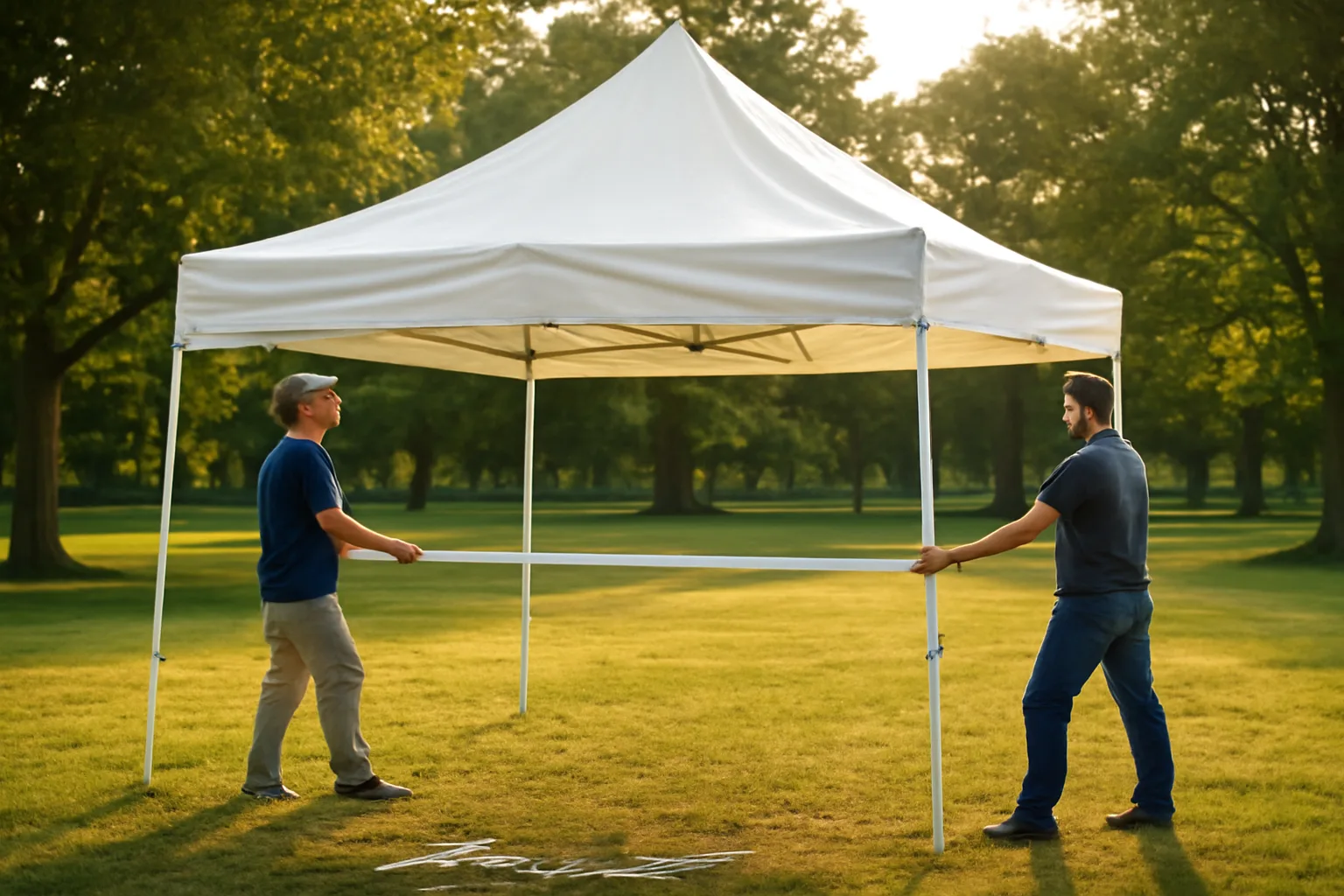
Tent rental is the short-term hire of a temporary shelter, usually a frame tent, pole tent, or tension structure, plus the labor to install it, hold it down, and take it down. You rent a product and a crew at once. The customer is buying shade, weather cover, and a footprint that matches a site plan.
It is not camping retail. It is not a venue lease. A party shop that hands you a boxed pop-up is in a related trade. The work people mean when they say tent rental is install work. Stakes or weights. Sidewalls. Sometimes floors, liners, and lighting.
The U.S. Census Bureau puts most of this trade in NAICS 532289, All Other Consumer Goods Rental. That class covers establishments that rent consumer goods, and party and banquet equipment rental sits in that bucket. [11]
Jobs last a few hours or a few days. Weddings, funerals, school fairs, restaurant patios, construction break areas. The structure comes down again. That is why fire officials treat it as a tent or membrane structure, not as a building you occupy all year.
Drop a 10x10 pop-up and walk away and you are in a thinner product. The paper path below still matters the moment you go past small open canopies.
Customers will call it a wedding tent or a party tent. Your contract should name the size, the wall plan, the hold-down method, and who owns weather risk. That last line is where operators get hurt.
How do you start tent rental?
You start on paper. Entity, tax IDs, insurance, then a local permit path for the first real tent. Buying vinyl first is how people burn cash.
Pick a legal structure with the state. The U.S. Small Business Administration walks through sole proprietorship, partnership, LLC, and corporation, and it explains how tax treatment follows the choice. [2] Most new operators pick an LLC. It is simple, and it puts a wall between personal assets and a stake that hits a buried line. Confirm formation rules and fees with your secretary of state. Those fees change. I will not invent them here.
Get an Employer Identification Number from the IRS even if you have no staff yet. The IRS says, "Applying for an EIN is a free service offered by the Internal Revenue Service." [1] Register for state sales tax if your state taxes the rental of tangible personal property. Many states do. Confirm with the state revenue department, not a comment thread.
Then insurance. Then a written install method. Then you quote. The first paid job still needs a local fire or building permit if the tent is over the size line your AHJ uses. That line is often 400 square feet under the model fire code. [3]
An EIN from the IRS costs $0 if you apply on IRS.gov. [1]
Walk the same path in more detail in What tent rental is and how you start the paper path and How to start tent rental and what the work really is.
Do you need a license to run tent rental?
There is no federal tent rental license. Full stop.
You still collect a stack of ordinary business credentials. State entity filing. A local business tax receipt or occupational license if your city or county issues one. A seller's permit or sales tax account. A resale certificate so you can buy inventory without paying tax twice, if your state allows it. The SBA's register-your-business guide is the federal overview of that stack. Confirm the actual forms with your state and city. [8]
Hire anyone and you add state unemployment, workers compensation, and federal employment tax accounts. The Fair Labor Standards Act generally requires overtime pay after 40 hours in a workweek for nonexempt employees, at one and one-half times the regular rate. [7]
Some cities treat party rental as a general business. Some want a contractor-style registration if you disturb soil with long stakes. A few historic districts want a separate events permit. Confirm with the clerk and the fire marshal. Do not assume a neighboring county's rule.
Flame certificates are not a license either. They are fabric test papers. You still need them on many permitted jobs. [3]
| Credential | Who issues it | When you need it |
|---|---|---|
| State entity filing | Secretary of state | Before you bank and contract [8] |
| EIN | IRS | Before payroll, often before banking [1] |
| Sales tax account | State revenue department | If rentals are taxable |
| Tent or membrane permit | Local fire or building official | When you exceed the local size line [3] |
What permit do you need to put a tent up?
You need whatever the authority having jurisdiction asks for that site, on that date. For most U.S. cities that adopted the International Fire Code, the trigger is size.
The 2021 International Fire Code requires a permit for tents and membrane structures over 400 square feet. The code text is blunt: "Tents and membrane structures having an area in excess of 400 square feet shall not be erected, operated or maintained for any purpose without first obtaining a permit and approval from the fire code official." [3]
There is a common exception for tents open on all sides if each tent is 700 square feet or less, the grouped area stays at or under 700 square feet without a 12-foot fire break, and you keep 12 feet to other tents and structures. [3] Do not memorize the exception and skip the call. Local amendments exist. Read the version your state and city adopted, not a blog summary.
Florida writes the Florida Fire Prevention Code into statute and has the State Fire Marshal adopt it. Tent rules there live in that code, not in a secret rental statute. Confirm the current edition with the local bureau. [4]
Cooking, heaters, enclosed sidewalls, and occupancy load can pull extra review. Construction documents, a site plan, exits, and an anchorage method show up on the application. Confirm the current packet with the fire prevention office that owns the address.
| IFC 2021 situation | Size line | What you file |
|---|---|---|
| Tents or membrane structures | Over 400 sq ft | Permit with the fire code official [3] |
| Open on all sides, isolated | 700 sq ft or less (exception) | Confirm the exception still applies locally [3] |
| Grouped open tents without a 12 ft break | Combined area over 700 sq ft | Treat as permitted [3] |
What paperwork do you complete before the first job?
Before you take a deposit, finish the boring stack.
State formation papers and a registered agent if the state wants one. [8] An EIN. [1] A business bank account in the entity name. A sales tax account if rentals are taxable. A general liability policy plus inland marine or equipment coverage, and hired or non-owned auto if you use personal trucks. Hire employees and you add workers compensation as your state requires.
On the job side, keep a current flame certificate for each fabric skin. IFC Chapter 31 points to a laboratory certificate that the material meets NFPA 701 flame propagation criteria before the permit is granted. [3] Keep a one-page wind action plan. Keep manufacturer install notes for the frames you own. Some jurisdictions want a PE-stamped ballast or staking calculation for larger tents or high wind sites. That is engineering, not a form you invent in Word.
If you need a stamp packet and you do not have an engineer on retainer, a one-time Wind-Load + Stamp Kit at $179 is one way people assemble the wind and stamp paper. It does not replace the local permit. Confirm what your fire marshal will accept.
ADA rules can hit the site even when you are not the venue. The 2010 ADA Standards for Accessible Design set accessible route and assembly rules for places of public accommodation. [5] Stakes, weights, and walls that block the only path will get you a problem you did not bid.
More of the first-job packet is in Tent rental guide for first jobs, permits, and paper.
How much money do you need to start tent rental?
Nobody has a clean national startup number. Equipment quotes move with vinyl, aluminum, and freight. I will not invent a kit price for a 20x20.
What you can pin down is the cheap paper. An EIN costs $0 if you apply on IRS.gov. [1] State formation and local license fees are real, and they are not the same in Alabama and California. Check the state pages, then look at tent rental cost in california and tent rental cost in florida if those are your markets. Other state cost notes sit next to them, including tent rental cost in colorado.
Used commercial frame tents show up on the secondary market. New commercial inventory costs far more than a big-box pop-up. Get three written quotes. Do not buy lighting packages, dance floors, and drape in month one unless a signed job pays for them.
Insurance down payments vary by loss history, radius, and whether you install. Ask two brokers who already write party rental. If a broker has never scheduled a tent, keep walking.
Labor is your other cash drain. Federal minimum wage is $7.25 an hour, and many states sit higher. [6] Overtime math starts after 40 hours for covered employees. [7] Crew quality costs more than the floor number. Pay for people who can square a frame.
What insurance does a tent rental company carry?
You carry general liability because a frame can come down and a guest can trip a guy line. You carry equipment coverage because a trailer gets stolen at a rest stop. You carry auto because the loss often happens on the road, not under the peak.
Workers compensation is a state statute product once you have employees. Sole-owner exemptions exist in some states and not in others. Confirm with the state workers compensation board. I will not quote a premium. Anyone who quotes you a national average is guessing.
Ask the broker about weather, collapse, and damage to the host site (irrigation, unmarked utilities). Ask whether install error is covered or excluded. Get additional insured language that matches venue contracts. Read the form. The certificate is not the policy.
Inland marine is the usual schedule for gear that moves. A businessowners policy may be enough for a tiny shop and too thin for a tent that seats 200. Confirm.
Do not start installs on a personal auto policy and hope. Tell the auto writer that you haul commercial gear. If they will not schedule the trailer, find someone who will.
What tents should you buy in year one?
Buy fewer commercial frames than your excitement wants. A pair of 20x20 or 20x30 frame tents, enough legs and fitments, clean vinyl, rated stakes, and a serious ballast option for asphalt will do more work than a 40x60 you cannot staff.
Pole tents need more clear ground and longer lay-out time. They look right for some weddings. They are the wrong first buy if your market is restaurant patios and school blacktop.
Skip cheap pop-up fleets if you are selling installed events. They fail in wind and they train customers to expect a $75 price. Sidewalls, one good trailer, and a lift plan for wet vinyl matter more than a third color of liner.
Match inventory to jobs you can already name. If you cannot list ten likely sites, you are not ready to order vinyl.
Hold-down gear is inventory, not an accessory. Asphalt, rooftop decks, and historic lawns will block stakes. If you cannot ballast, you cannot take the job.
A broader gear-plus-paper pass is in The tent rental guide for licenses, tents, and year one.
How do flame certificates and wind load work?
Flame paper is a lab result, not a spray bottle story. IFC Chapter 31 tells the owner or agent to file a certificate from an approved testing laboratory that the tent material meets NFPA 701 flame propagation criteria before the permit is granted. [3] Keep the certificate with the skin. Replace it when the AHJ says the date is stale.
California also makes it unlawful to operate certain tents, awnings, or fabric enclosures used as places of assemblage unless the fabric is nonflammable or treated and kept in a flame-retardant condition. [9] Work that state and you should read the Health and Safety Code section and the State Fire Marshal fabric rules. Do not guess from another state's stamp.
Wind load is physics plus a decision tree. You stake or you ballast to a design wind speed for that site. You watch the forecast. You postpone or strike when you hit your stop number. The National Weather Service publishes wind safety guidance for outdoor conditions that can throw a person off balance and turn loose objects into hazards. [10] A tent is a sail. If you do not have a written stop, you will argue with a bride in a rising gust.
Some sites want an engineer stamp on the ballast chart. Some do not. Confirm. Do not photocopy another company's calcs.
What does first-year tent rental work actually look like?
Year one is delivery math. You quote, you visit the site or you regret it, you mark utilities, you pull the permit, you stage, you install, you stand by or you leave a written weather plan, you strike, you dry vinyl so it does not rot in the bag.
You will underbid labor. Wet vinyl is heavier than the brochure. Night strikes after a wedding run long. Parking can kill a timeline. Call before you dig, every time you plan to drive long steel stakes. Utility locate rules are state and local. Confirm the number and the wait. I will not invent the wait.
OSHA still applies to your crew. Personal protective equipment rules live in 29 CFR 1910.132 when the employer has workplace hazards. [12] Outdoor installs in heat need water, rest, and a plan. OSHA's heat index guide is written for that kind of day. [13]
Paper you already filed will get asked for again. Keep a job folder: contract, site plan, permit, flame cert, insurance cert, locate ticket, photos of the empty site and the finished install.
See Tent rental guide 100 for first-year paper and permits.
How do you price a tent rental job?
Price the labor and the truck first, then the vinyl. Price a 20x30 at what the Facebook group said and you will eat the second trip when the site turns out to be brick.
Build a simple sheet: load-out hours, drive, install crew hours, stand-by or weather check, strike, dry time, permit pass-through, damage waiver, and a margin that survives a blown Saturday. Charge for mileage. Charge for ballast when you cannot stake. Charge for same-day date changes.
I do not have a national rate table that is honest. County demand and crew wages move the number. Look at local invoices if a venue will share a sample rider, then build your own cost. If a competitor is half your number, they are skipping insurance, permits, or sleep.
Pass permit fees through at cost plus your time to stand in line. Do not hide them and do not mark them up into something ugly.
Write weather in the contract. If the client owns the go or no-go call after your stop number, say so. If you own it, say so. Silence is how you donate a crew day.
What taxes apply to tent rental income?
Federal income tax on the profit. Self-employment tax if you are a sole proprietor or a single-member LLC that did not elect corporate treatment. Employment taxes if you have staff. IRS Publication 334 is the small-business tax guide most operators should actually open. [14]
Depreciation: IRS Publication 946 is the MACRS rulebook. A lot of rental equipment used in service businesses lands in 5-year property under the asset class tables, but classification is a CPA call on your facts. [15] Do not take my sentence to an audit.
Sales tax on the rental charge is a state question. Some states tax the tent and exempt the labor if you invoice them apart. Some tax the bundle. Some exempt certain nonprofit events. Confirm with the state department of revenue and write your invoices the way that state wants.
Local rental taxes and tourism taxes show up in resort towns. Confirm.
Keep mileage, crew hours, permit receipts, and repair invoices. Tent rental looks simple until you cannot prove cost of goods and labor on a Saturday in July.
Where do new tent rental operators waste money?
They buy a 40x80 before they have a crew. They buy used vinyl with no flame cert. They pay a random website for an EIN. [1] They skip utility locates. They take a waterfront job with pop-up weights. They argue with a fire marshal instead of bringing a site plan.
They also overbuild the shop. You do not need a retail storefront. You need dry storage, a hose, and a place to park a trailer.
Training is not a waste. A day with an experienced installer (paid, on the books) will save frames. Fancy software in month one is a waste. A shared calendar and a written contract template are enough.
If a job needs a stamp you cannot produce, decline it or hire the engineer. Copying another operator's ballast sheet is how you inherit their mistakes.
Confirm every form with the board that will stamp it. TentStakePath is an independent publisher, not a law firm and not a service company. If you want a wind and stamp packet assembled, the next step is /start.
Frequently asked questions
What is tent rental?
Tent rental is short-term hire of a frame, pole, or tension tent plus the crew to install, hold down, and strike it. It is not a venue and it is not a boxed pop-up sold over a counter. Most U.S. operators sit in Census NAICS 532289 with other consumer and party goods rental. Fire officials still treat the structure as a temporary tent or membrane structure.
How do you start tent rental?
Start on paper. Form an entity with your secretary of state, get a free EIN from the IRS, open a business bank account, register for sales tax if your state taxes rentals, and buy insurance that actually covers install work. Quote only after you know the local tent permit line, often 400 square feet under the International Fire Code. Confirm every fee with the board that collects it.
Is there a national tent rental license?
No. There is no federal tent rental license. You still need ordinary credentials: a state entity, often a local business license, a sales tax account if rentals are taxable, and employment accounts if you hire. Each job site can also need a tent or membrane structure permit from the local fire or building official. Confirm the packet for that address.
How big can a tent be without a permit?
Under the 2021 International Fire Code, tents and membrane structures over 400 square feet need a permit and fire official approval. An exception often applies to open-sided tents of 700 square feet or less if spacing rules are met. Cities amend the model code. Ask the bureau that owns the site. Do not assume the exception.
Do I need an EIN if I am a sole proprietor?
You may be able to use a Social Security number in a few narrow cases, but get an EIN anyway. It is free on IRS.gov, banks often want it, and you will need it the day you hire. The IRS warns that websites charge for this free filing. Confirm current rules on the IRS EIN application page before you file.
Is tent rental subject to sales tax?
Often yes, because many states tax the rental of tangible personal property. Some tax labor too unless you invoice it apart. Some exempt certain nonprofit or government events. This is a state revenue question, not a fire-code question. Confirm with your department of revenue and print invoices the way that office wants them.
Do I need a PE stamp for every tent job?
No. Many small permitted tents clear with a site plan, flame certificate, and the manufacturer's install notes. Larger tents, high wind sites, rooftop decks, and ballast-only installs are where officials ask for an engineer. Confirm with the fire marshal on that address. Do not photocopy another company's calculations.
What is NFPA 701 on a tent?
NFPA 701 is the flame-propagation test method the International Fire Code points to for tent and membrane fabric. Before many permits are granted, the owner or agent files a laboratory certificate that the material meets Test Method 1 or 2, as appropriate. Keep that paper with the skin. A store receipt is not a flame certificate.
Can I run tent rental out of my house?
Sometimes, if zoning allows a home occupation and you have dry storage plus legal parking for a trailer. Many cities block commercial truck traffic or outdoor storage on a residential lot. Confirm zoning and any home-occupation permit with the planning desk. A cheap storage yard is often cleaner than a neighbor fight.
Do weekend helpers trigger workers compensation?
If they are employees, yes in most states, including Saturday wedding crews. Labeling someone a contractor does not settle it. State workers compensation boards and the FLSA look at control, pay, and whose tools get used. Confirm with the state board and a payroll advisor before the first paid helper climbs a ladder.
Who calls off a tent in high wind?
Your contract should say. Write a stop number, watch a real forecast, and strike or postpone when you hit it. The National Weather Service publishes outdoor wind safety guidance because wind throws people off balance and turns loose objects into hazards. A tent is a sail. Do not leave that call to a toast mid-gust.
What NAICS code do tent rental companies use?
Most party and banquet tent rental sits in NAICS 532289, All Other Consumer Goods Rental, per the U.S. Census Bureau's 2022 definitions. Some mixed shops land in 532310, General Rental Centers. Use the class that matches what you actually rent. Confirm on the Census NAICS page if a bank or insurer asks.
Do pop-up canopies need the same permits as frame tents?
Small open pop-ups often fall under the fire-code size exceptions, especially at or under the 400 and 700 square foot lines. Group a field of them and you can cross the line. Sidewalls change the review. Confirm with the local fire official. Selling a cheap pop-up is not the same business as installing a commercial frame tent.
How far ahead should I apply for a tent permit?
Ask the bureau that owns the address. Some take a walk-in packet. Some want plans days before the event, and some want more when cooking or large occupancy is involved. I will not invent a processing time. Do not promise a client a date until that office tells you what it needs and when it will look at it.
Sources
- IRS, Apply for an Employer Identification Number (EIN) Online: Applying for an EIN is a free IRS service; do not pay a third-party website for it.
- U.S. Small Business Administration, Choose a business structure: SBA explains sole proprietorship, partnership, LLC, and corporation choices and that tax treatment follows the structure.
- ICC, 2021 International Fire Code Chapter 31: Tents and membrane structures over 400 square feet require a permit; open-sided exception commonly 700 square feet; flame certificates reference NFPA 701.
- Florida Senate, Statute 633.202 Florida Fire Prevention Code: Florida statute requires adoption of the Florida Fire Prevention Code by the State Fire Marshal.
- U.S. Department of Justice, 2010 ADA Standards for Accessible Design: The 2010 ADA Standards set accessible route and assembly rules that can apply at public event sites.
- U.S. Department of Labor Wage and Hour Division, Minimum Wage: The federal minimum wage is $7.25 per hour.
- U.S. Department of Labor, Fact Sheet #23 Overtime Pay Requirements: FLSA generally requires overtime after 40 hours in a workweek at one and one-half times the regular rate for covered nonexempt employees.
- U.S. Small Business Administration, Register your business: New businesses register with state and local governments for entity, tax, and license accounts.
- California Legislative Information, Health and Safety Code 13115: California makes it unlawful to operate certain assemblage tents unless fabric is nonflammable or maintained flame-retardant.
- National Weather Service, Wind Safety During a Storm: NWS publishes outdoor wind safety guidance for conditions that can throw people off balance and turn loose objects into hazards.
- U.S. Census Bureau, NAICS 2022 definition 532289: NAICS 532289 covers establishments primarily engaged in renting consumer goods, including party and banquet equipment rental.
- OSHA, 29 CFR 1910.132 Personal Protective Equipment: Employers must provide and require PPE when workplace hazards are present.
- OSHA, Using the Heat Index: A Guide for Employers (OSHA 3743): OSHA guidance tells employers to use water, rest, and work changes to protect outdoor workers in heat.
- IRS, Publication 334 Tax Guide for Small Business: Publication 334 is the IRS small-business guide to federal income and self-employment tax on business profit.
- IRS, Publication 946 How To Depreciate Property: Publication 946 sets MACRS classes; much service-business equipment is 5-year property under the asset class tables, subject to CPA classification.